茀 (fú) means "Luxuriant growth" in Chinese. It has 9 strokes with the radical 艹.
Rated 4/5 in difficulty (challenging).
Appears in 3+ common words including 茀郁 (fú yù), 茀路 (fú lù), 茀道 (fú dào).
Due to its 9 strokes, Hanzi Writer's error detection shows 茀 requires focused practice — most learners need 10+ attempts for consistent accuracy.
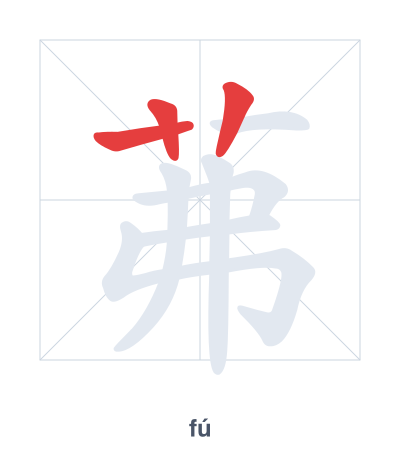
Open Hanzi Writer to see the animated stroke order and practice writing 茀 with real-time feedback.
The character 茀 (fú) is written with 9 strokes. Follow the standard Chinese stroke order: top to bottom, left to right, outside before inside. The radical 艹 is one of its key components.
Practice the correct stroke order with the Hanzi Writer app to see animated stroke-by-stroke guidance with real-time feedback.
茀 means Luxuriant growth.
茀 is a phono-semantic compound: the radical 艹 (grass) indicates lush vegetation, while 弗 (fú) serves as a phonetic component. Its meaning 'luxuriant growth' directly evokes thick, flourishing grass or plants covering the ground.
💡 Memory Tip: Imagine a patch of grass (艹) growing so wildly that it bends the fence (弗) into a twisted shape.
这里的草木长得茀郁。
zhè lǐ de cǎo mù zhǎng dé fú yù
The vegetation here grows densely.
杂草已经茀路了。
zá cǎo yǐ jīng fú lù le
Weeds have overgrown and blocked the path.
山上的茀道很难走。
shān shàng de fú dào hěn nán zǒu
The overgrown path on the mountain is difficult to walk.
Open Hanzi Writer to see the animated stroke order and practice writing 茀 with real-time feedback.
✨ Animated stroke order · Handwriting recognition · HSK-graded practice · Free to use
茀 is made of two parts: the top radical 艹 (grass) and the bottom component 弗 (fú). The grass radical indicates the meaning relates to plants, while 弗 provides the pronunciation. Together they represent lush, dense plant growth.