伕 (fū) means "A common laborer or porter" in Chinese. It has 6 strokes with the radical 亻.
Rated 2.9/5 in difficulty (moderate).
Appears in 3+ common words including 挑伕 (tiāo fū), 轿伕 (jiào fū), 伕役 (fū yì).
Hanzi Writer's stroke validation shows learners typically need 5-8 attempts to write 伕 with correct proportion and order.
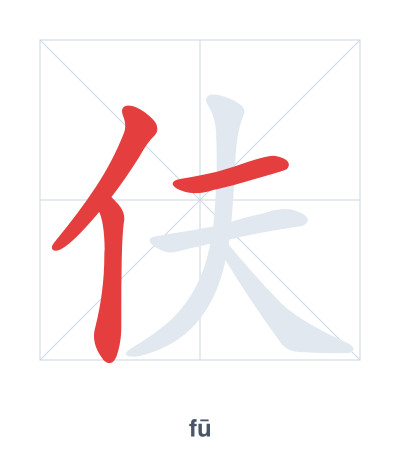
Open Hanzi Writer to see the animated stroke order and practice writing 伕 with real-time feedback.
The character 伕 (fū) is written with 6 strokes. Follow the standard Chinese stroke order: top to bottom, left to right, outside before inside. The radical 亻 is one of its key components.
Practice the correct stroke order with the Hanzi Writer app to see animated stroke-by-stroke guidance with real-time feedback.
伕 means A common laborer or porter.
伕 is a compound character combining the radical 亻 (person) with 夫 (adult male). It depicts a man engaged in manual work, specifically as a porter or common laborer. The character reinforces the idea of a male worker by adding the person radical to 夫.
💡 Memory Tip: Picture a man (夫) with a heavy sack slung over his shoulder, the person radical (亻) showing he is a human laborer struggling under the load.
挑伕在山路上走。
tiāo fū zài shān lù shàng zǒu
The porter is walking on the mountain path.
轿伕们抬着轿子。
jiào fū men tái zhe jiào zi
The porters are carrying the sedan chair.
古代有很多伕役。
gǔ dài yǒu hěn duō fū yì
There were many corvée laborers in ancient times.
Open Hanzi Writer to see the animated stroke order and practice writing 伕 with real-time feedback.
✨ Animated stroke order · Handwriting recognition · HSK-graded practice · Free to use
伕 is made of the radical 亻 (person) on the left and 夫 (fū, man) on the right. The person radical indicates it relates to people, and 夫 suggests a male laborer. Together, they mean a common laborer or porter who carries loads.