忿 (fèn) means "anger; indignation; resentment" in Chinese. It has 8 strokes with the radical 心.
Rated 3.7/5 in difficulty (challenging).
Appears in 3+ common words including 气忿 (qì fèn), 忿忿不平 (fèn fèn bù píng), 忿恨 (fèn hèn).
Due to its 8 strokes, Hanzi Writer's error detection shows 忿 requires focused practice — most learners need 10+ attempts for consistent accuracy.
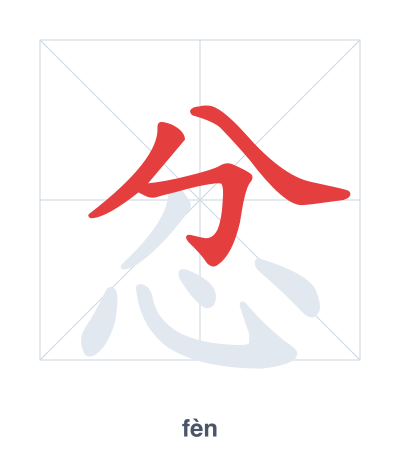
Open Hanzi Writer to see the animated stroke order and practice writing 忿 with real-time feedback.
The character 忿 (fèn) is written with 8 strokes. Follow the standard Chinese stroke order: top to bottom, left to right, outside before inside. The radical 心 is one of its key components.
Practice the correct stroke order with the Hanzi Writer app to see animated stroke-by-stroke guidance with real-time feedback.
忿 means anger; indignation; resentment.
忿 combines the phonetic component 分 (fēn, meaning 'divide' or 'split') with the heart radical 心 (xīn), suggesting a heart torn apart by anger or resentment. The character visually depicts how indignation divides one's inner emotional state.
💡 Memory Tip: Picture a heart (心) being split in two (分) by a bolt of red-hot anger—that visceral split is 忿.
他心里很气忿。
tā xīn lǐ hěn qì fèn
He felt very indignant.
他感到忿忿不平。
tā gǎn dào fèn fèn bù píng
He feels indignant.
别再心存忿恨。
bié zài xīn cún fèn hèn
Stop harboring resentment.
Open Hanzi Writer to see the animated stroke order and practice writing 忿 with real-time feedback.
✨ Animated stroke order · Handwriting recognition · HSK-graded practice · Free to use
忿 is made of two parts: 分 (fēn, meaning 'divide') on top and 心 (xīn, meaning 'heart') on the bottom. Together they suggest a 'divided heart' or a heart that is disturbed, which leads to feelings of anger or resentment.