悱 (fěi) means "to want to speak but find no words" in Chinese. It has 11 strokes with the radical 忄.
Rated 4.2/5 in difficulty (advanced).
Appears in 3+ common words including 悱恻 (fěi cè), 悱愤 (fěi fèn), 悱然 (fěi rán).
Due to its 11 strokes, Hanzi Writer's error detection shows 悱 requires focused practice — most learners need 10+ attempts for consistent accuracy.
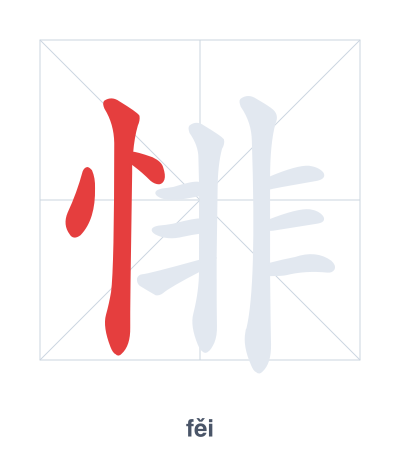
Open Hanzi Writer to see the animated stroke order and practice writing 悱 with real-time feedback.
The character 悱 (fěi) is written with 11 strokes. Follow the standard Chinese stroke order: top to bottom, left to right, outside before inside. The radical 忄 is one of its key components.
Practice the correct stroke order with the Hanzi Writer app to see animated stroke-by-stroke guidance with real-time feedback.
悱 means to want to speak but find no words.
悱 combines the heart radical 忄 (心, relating to emotions) with 非 (fēi, meaning 'wrong' or 'not'), suggesting a heart that feels 'not right' or blocked. This visually conveys the inner frustration of having something to say but being unable to express it—emotionally stuck, as if the words are 'non-existent' in the heart.
💡 Memory Tip: Imagine a heart (忄) with two crossed bars (非) across your throat, choking back all the words you want to say but can't get out.
这个故事很悱恻。
zhè ge gù shì hěn fěi cè
This story is very poignant.
他内心感到悱愤。
tā nèi xīn gǎn dào fěi fèn
He felt a sense of pent-up indignation.
他听后悱然泪下。
tā tīng hòu fěi rán lèi xià
He shed tears of grief after hearing it.
Open Hanzi Writer to see the animated stroke order and practice writing 悱 with real-time feedback.
✨ Animated stroke order · Handwriting recognition · HSK-graded practice · Free to use
The left component 忄 (heart radical) shows this character is about emotions. The right component 非 means 'not' or 'false', suggesting an inability — together they convey the feeling of wanting to speak but being unable to find words.