梵 (fàn) means "Brahma, Sanskrit, or Buddhist" in Chinese. It has 11 strokes with the radical 木.
Rated 3.9/5 in difficulty (challenging).
Appears in 3+ common words including 梵文 (fàn wén), 梵蒂冈 (fàn dì gāng), 梵音 (fàn yīn).
Due to its 11 strokes, Hanzi Writer's error detection shows 梵 requires focused practice — most learners need 10+ attempts for consistent accuracy.
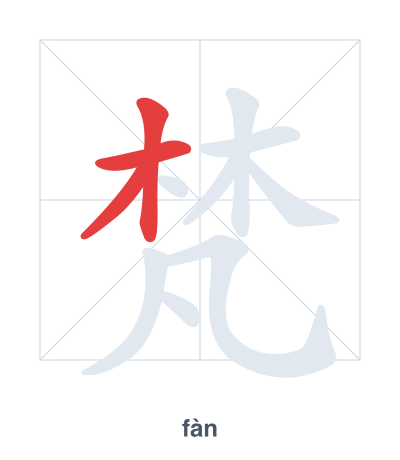
Open Hanzi Writer to see the animated stroke order and practice writing 梵 with real-time feedback.
The character 梵 (fàn) is written with 11 strokes. Follow the standard Chinese stroke order: top to bottom, left to right, outside before inside. The radical 木 is one of its key components.
Practice the correct stroke order with the Hanzi Writer app to see animated stroke-by-stroke guidance with real-time feedback.
梵 means Brahma, Sanskrit, or Buddhist.
梵 is a phono-semantic compound: 凡 (fán) provides the phonetic approximation to Sanskrit 'Brahma', and 林 (two trees, 'forest') suggests the serene, natural purity associated with Buddhist or Brahmanical concepts.
💡 Memory Tip: Imagine a dense forest (林) where an ordinary (凡) tree glows with divine light—that's the sacred Bodhi tree of Buddha, symbolizing 梵's Buddhist and Sanskrit connections.
他在学习梵文。
tā zài xué xí fàn wén
He is studying Sanskrit.
梵蒂冈是一个小国家。
fàn dì gāng shì yí gè xiǎo guó jiā
Vatican City is a small country.
寺庙里传来了梵音。
sì miào lǐ chuán lái le fàn yīn
Buddhist chanting was heard from the temple.
Open Hanzi Writer to see the animated stroke order and practice writing 梵 with real-time feedback.
✨ Animated stroke order · Handwriting recognition · HSK-graded practice · Free to use
梵 is made of 木 (tree) on top and 凡 (ordinary) below. This combination was used to transliterate the Sanskrit word 'Brahma', linking the character to Buddhist and Indian concepts.