藩 (fān) means "fence; barrier; vassal state" in Chinese. It has 18 strokes with the radical 艹.
Rated 4.2/5 in difficulty (advanced).
Appears in 3+ common words including 藩篱 (fān lí), 藩王 (fān wáng), 藩屏 (fān píng).
Due to its 18 strokes, Hanzi Writer's error detection shows 藩 requires focused practice — most learners need 10+ attempts for consistent accuracy.
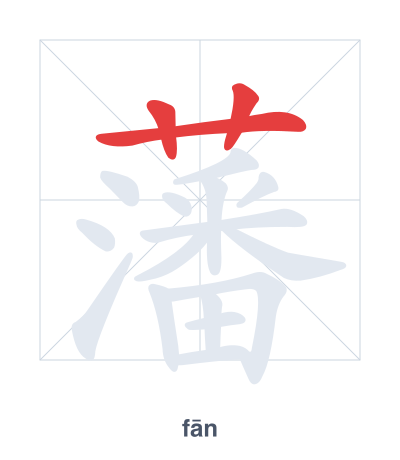
Open Hanzi Writer to see the animated stroke order and practice writing 藩 with real-time feedback.
The character 藩 (fān) is written with 18 strokes. Follow the standard Chinese stroke order: top to bottom, left to right, outside before inside. The radical 艹 is one of its key components.
Practice the correct stroke order with the Hanzi Writer app to see animated stroke-by-stroke guidance with real-time feedback.
藩 means fence; barrier; vassal state.
藩 is a compound character: the grass radical 艹 (plants) on top of 潘 (fān, a phonetic component). Together they depict a barrier made of thorny vegetation or a hedge, originally a fence marking a boundary. Later it extended to mean 'vassal state' as a protective buffer zone around a kingdom.
💡 Memory Tip: Picture a grassy fence (艹) surrounding a watery field (氵+田 inside 潘) that marks the border of a vassal state.
我们要打破藩篱。
wǒ men yào dǎ pò fān lí
We should break down barriers.
古代有很多藩王。
gǔ dài yǒu hěn duō fān wáng
There were many vassal kings in ancient times.
他是国家的藩屏。
tā shì guó jiā de fān píng
He is the protector of the nation.
Open Hanzi Writer to see the animated stroke order and practice writing 藩 with real-time feedback.
✨ Animated stroke order · Handwriting recognition · HSK-graded practice · Free to use
藩 has the grass radical 艹 on top, suggesting materials like plants used for a fence. Below is 潘, which contains 氵 (water) and 番 (meaning 'foreign' or 'turn over'). Together, they hint at a barrier made of plants that separates territories, like a fence or a vassal state's border.