萼 (è) means "calyx; sepal" in Chinese. It has 12 strokes with the radical 艹.
Rated 4.2/5 in difficulty (advanced).
Appears in 3+ common words including 花萼 (huā è), 萼片 (è piàn), 萼绿 (è lǜ).
Due to its 12 strokes, Hanzi Writer's error detection shows 萼 requires focused practice — most learners need 10+ attempts for consistent accuracy.
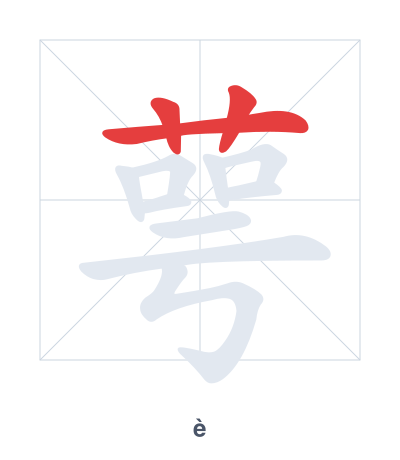
Open Hanzi Writer to see the animated stroke order and practice writing 萼 with real-time feedback.
The character 萼 (è) is written with 12 strokes. Follow the standard Chinese stroke order: top to bottom, left to right, outside before inside. The radical 艹 is one of its key components.
Practice the correct stroke order with the Hanzi Writer app to see animated stroke-by-stroke guidance with real-time feedback.
萼 means calyx; sepal.
萼 is a phono-semantic compound: the radical 艹 (grass/plant) indicates it relates to plants, while 咢 (è) provides the sound and originally depicted two hands (吅) cupping a mouth (口), symbolizing protection—mirroring the calyx's role in shielding the flower bud.
💡 Memory Tip: Picture the top part 咢 as two hands (吅) gently cupping a mouth (口) at the center, just like the green sepals of the calyx (萼) cradle the flower bud from below.
花萼保护着花瓣。
huā è bǎo hù zhe huā bàn
The calyx protects the petals.
这是一个绿色的萼片。
zhè shì yí gè lǜ sè de è piàn
This is a green sepal.
这种颜色叫萼绿。
zhè zhǒng yán sè jiào è lǜ
This color is called calyx green.
Open Hanzi Writer to see the animated stroke order and practice writing 萼 with real-time feedback.
✨ Animated stroke order · Handwriting recognition · HSK-graded practice · Free to use
The character 萼 is composed of the radical 艹 (grass) on top, indicating it relates to plants, and 咢 (è) below, which provides the sound. Together, 艹 + 咢 form a character meaning "calyx," the green leaf-like part at the base of a flower.