莪 (é) means "zedoary; a type of mugwort" in Chinese. It has 10 strokes with the radical 艹.
Rated 4.2/5 in difficulty (advanced).
Appears in 3+ common words including 莪蒿 (é hāo), 莪术 (é shù), 采莪 (cǎi é).
Due to its 10 strokes, Hanzi Writer's error detection shows 莪 requires focused practice — most learners need 10+ attempts for consistent accuracy.
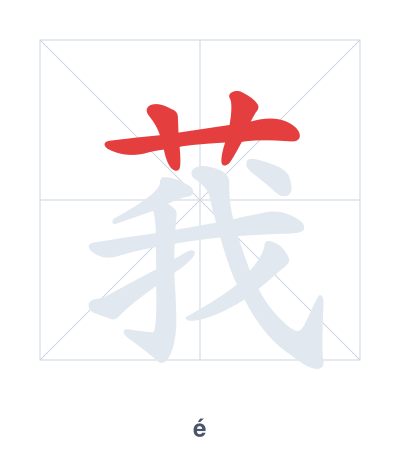
Open Hanzi Writer to see the animated stroke order and practice writing 莪 with real-time feedback.
The character 莪 (é) is written with 10 strokes. Follow the standard Chinese stroke order: top to bottom, left to right, outside before inside. The radical 艹 is one of its key components.
Practice the correct stroke order with the Hanzi Writer app to see animated stroke-by-stroke guidance with real-time feedback.
莪 means zedoary; a type of mugwort.
莪 is a phono-semantic compound: the grass radical (艹) indicates it's a plant, while 我 (wǒ, meaning 'self') provides the pronunciation. It specifically refers to species of medicinal mugwort or zedoary, aromatic herbs used in traditional medicine.
💡 Memory Tip: Picture yourself saying 'I (我) am covered in grass (艹) like a wild mugwort plant, tangled and aromatic.'
莪蒿长在水边。
é hāo zhǎng zài shuǐ biān
Wormwood grows by the water.
莪术是一种中药材。
é shù shì yī zhǒng zhōng yào cái
Zedoary is a type of traditional Chinese medicine.
她在山坡上采莪。
tā zài shān pō shàng cǎi é
She is picking mugwort on the hillside.
Open Hanzi Writer to see the animated stroke order and practice writing 莪 with real-time feedback.
✨ Animated stroke order · Handwriting recognition · HSK-graded practice · Free to use
The character 莪 is made of the grass radical 艹 on top, showing it is a kind of plant. The bottom part is 我 (wǒ, meaning 'self' or 'I'), which gives a hint to the pronunciation 'é' even though the tones are different.