蒿 (hāo) means "Wormwood" in Chinese. It has 13 strokes with the radical 艹.
Rated 4.2/5 in difficulty (advanced).
Appears in 3+ common words including 青蒿 (qīng hāo), 蒿草 (hāo cǎo), 蒿子 (hāo zi).
Due to its 13 strokes, Hanzi Writer's error detection shows 蒿 requires focused practice — most learners need 10+ attempts for consistent accuracy.
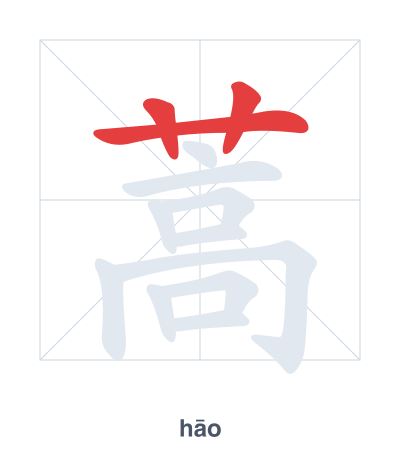
Open Hanzi Writer to see the animated stroke order and practice writing 蒿 with real-time feedback.
The character 蒿 (hāo) is written with 13 strokes. Follow the standard Chinese stroke order: top to bottom, left to right, outside before inside. The radical 艹 is one of its key components.
Practice the correct stroke order with the Hanzi Writer app to see animated stroke-by-stroke guidance with real-time feedback.
蒿 means Wormwood.
蒿 is a phono-semantic compound: the radical 艹 indicates it's a type of plant (grass), while 高 (gāo, meaning 'tall' or 'high') provides phonetic and semantic hints, as wormwood often grows tall and upright.
💡 Memory Tip: Imagine a tall stalk of wormwood (艹) reaching so high (高) that it pokes a hole in the clouds.
青蒿可以做药。
qīng hāo kě yǐ zuò yào
Sweet wormwood can be used for medicine.
地上长满了蒿草。
dì shàng zhǎng mǎn le hāo cǎo
The ground is covered with wormwood.
蒿子长得很高。
hāo zi zhǎng dé hěn gāo
The wormwood grows very tall.
Open Hanzi Writer to see the animated stroke order and practice writing 蒿 with real-time feedback.
✨ Animated stroke order · Handwriting recognition · HSK-graded practice · Free to use
蒿 is made of two parts: the top radical 艹 (grass) and the bottom part 高 (gāo, meaning tall or high). The grass radical shows that 蒿 is a type of plant, and the bottom part 高 gives a hint to its pronunciation (hāo), though not exactly the same. Together, they represent a tall grass-like plant called wormwood.