埵 (duǒ) means "mound / heap of earth" in Chinese. It has 11 strokes with the radical 土.
Rated 4.2/5 in difficulty (advanced).
Appears in 3+ common words including 堆埵 (duī duǒ), 泥埵 (ní duǒ), 埵积 (duǒ jī).
Due to its 11 strokes, Hanzi Writer's error detection shows 埵 requires focused practice — most learners need 10+ attempts for consistent accuracy.
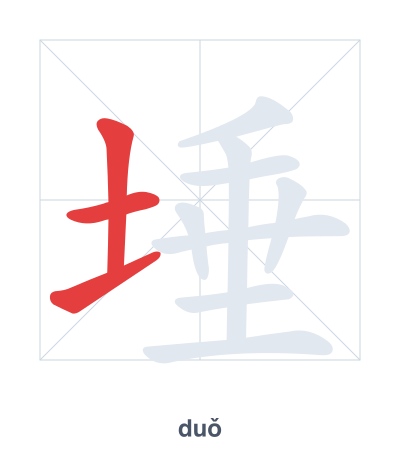
Open Hanzi Writer to see the animated stroke order and practice writing 埵 with real-time feedback.
The character 埵 (duǒ) is written with 11 strokes. Follow the standard Chinese stroke order: top to bottom, left to right, outside before inside. The radical 土 is one of its key components.
Practice the correct stroke order with the Hanzi Writer app to see animated stroke-by-stroke guidance with real-time feedback.
埵 means mound / heap of earth.
埵 is a phono-semantic compound: the radical 土 (earth) indicates the material, and the phonetic component 㐌 (duǒ, ancient form meaning 'to heap') suggests the idea of a pile or mound of earth.
💡 Memory Tip: Picture a mound of earth (土) so tall that a person on top (the right side 㐌, resembling a bent figure) has to balance carefully to avoid rolling down the heap.
土被堆埵在路边。
tǔ bèi duī duǒ zài lù biān
Dirt was piled up by the roadside.
小孩捏了一个泥埵。
xiǎo hái niē le yí gè ní duǒ
The child molded a lump of mud.
泥沙在河口埵积。
ní shā zài hé kǒu duǒ jī
Silt and sand accumulated at the river mouth.
Open Hanzi Writer to see the animated stroke order and practice writing 埵 with real-time feedback.
✨ Animated stroke order · Handwriting recognition · HSK-graded practice · Free to use
The character 埵 is made of the radical 土 (earth) on the left, and a right component that suggests a pile or heap. The radical directly connects to the meaning 'mound of earth,' while the right part visually reinforces the idea of something stacked up.