镦 (duì) means "Upset (metalworking)" in Chinese. It has 17 strokes with the radical 钅.
Rated 4.2/5 in difficulty (advanced).
Appears in 3+ common words including 镦粗 (duì cū), 镦头 (duì tóu), 镦锻 (duì duàn).
Due to its 17 strokes, Hanzi Writer's error detection shows 镦 requires focused practice — most learners need 10+ attempts for consistent accuracy.
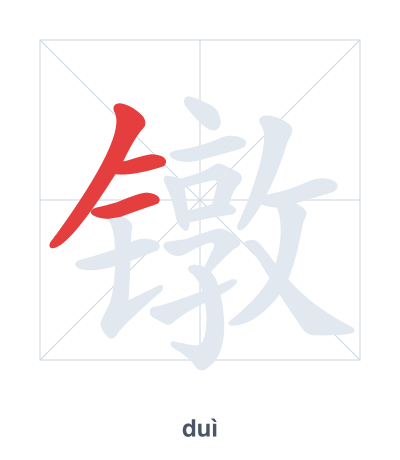
Open Hanzi Writer to see the animated stroke order and practice writing 镦 with real-time feedback.
The character 镦 (duì) is written with 17 strokes. Follow the standard Chinese stroke order: top to bottom, left to right, outside before inside. The radical 钅 is one of its key components.
Practice the correct stroke order with the Hanzi Writer app to see animated stroke-by-stroke guidance with real-time feedback.
镦 means Upset (metalworking).
镦 is a compound character combining the metal radical 钅 with 敦, which provides phonetic cues and also hints at the action of pressing or compacting—as in upset forging where metal is struck to thicken it.
💡 Memory Tip: Picture a blacksmith taking a piece of metal (钅) and repeatedly 'dun-dun-dunning' it with a heavy hammer (敦) to make it bulge and thicken.
工人正在镦粗钢筋。
gōng rén zhèng zài duì cū gāng jīn
The worker is upsetting the steel bars.
这个螺栓需要重新镦头。
zhè ge luó shuān xū yào chóng xīn duì tóu
This bolt needs to be re-headed.
镦锻是一种金属加工工艺。
duì duàn shì yī zhǒng jīn shǔ jiā gōng gōng yì
Upset forging is a metalworking process.
Open Hanzi Writer to see the animated stroke order and practice writing 镦 with real-time feedback.
✨ Animated stroke order · Handwriting recognition · HSK-graded practice · Free to use
镦 is composed of the radical 钅 (metal) on the left and 敦 on the right. 钅 shows it is related to metal, while 敦 contributes the sound and suggests the action of pressing or shaping. Together, these parts point to the metalworking process of upsetting—thickening metal by hammering or pressing.