碓 (duì) means "Stone mortar for hulling rice" in Chinese. It has 13 strokes with the radical 石.
Rated 4.2/5 in difficulty (advanced).
Appears in 3+ common words including 水碓 (shuǐ duì), 石碓 (shí duì), 碓房 (duì fáng).
Due to its 13 strokes, Hanzi Writer's error detection shows 碓 requires focused practice — most learners need 10+ attempts for consistent accuracy.
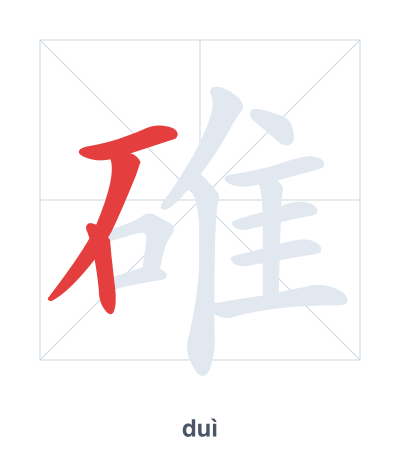
Open Hanzi Writer to see the animated stroke order and practice writing 碓 with real-time feedback.
The character 碓 (duì) is written with 13 strokes. Follow the standard Chinese stroke order: top to bottom, left to right, outside before inside. The radical 石 is one of its key components.
Practice the correct stroke order with the Hanzi Writer app to see animated stroke-by-stroke guidance with real-time feedback.
碓 means Stone mortar for hulling rice.
The character 碓 combines the radical 石 (stone), showing the mortar's material, with 隹 (a bird) that provides the sound. In ancient rice-hulling, the pestle's repetitive pounding resembles a bird pecking, linking the image to the action.
💡 Memory Tip: Picture a stone mortar (石) where a bird (隹) uses its beak as a pestle to pound rice with steady pecking motions.
农民用水碓加工粮食。
nóng mín yòng shuǐ duì jiā gōng liáng shí
Farmers use a water-powered pestle to process grain.
院子里有一个旧石碓。
yuàn zi lǐ yǒu yí gè jiù shí duì
There is an old stone mortar in the yard.
碓房里有很多米。
duì fáng lǐ yǒu hěn duō mǐ
There is a lot of rice in the hulling mill.
Open Hanzi Writer to see the animated stroke order and practice writing 碓 with real-time feedback.
✨ Animated stroke order · Handwriting recognition · HSK-graded practice · Free to use
The character 碓 is composed of two parts: the left side 石 (stone) and the right side 隹 (a short-tailed bird). The stone radical indicates that the object is made of stone, while 隹 provides the pronunciation. Together, they represent a stone mortar used for hulling rice.