兑 (duì) means "to exchange, to convert" in Chinese. It has 7 strokes with the radical 儿, and is HSK Level 7.
Rated 3.2/5 in difficulty (challenging).
Harder than 9% of HSK Level 7 characters.
Appears in 3+ common words including 兑换 (duì huàn), 兑现 (duì xiàn), 汇兑 (huì duì).
Due to its 7 strokes, Hanzi Writer's error detection shows 兑 requires focused practice — most learners need 10+ attempts for consistent accuracy.
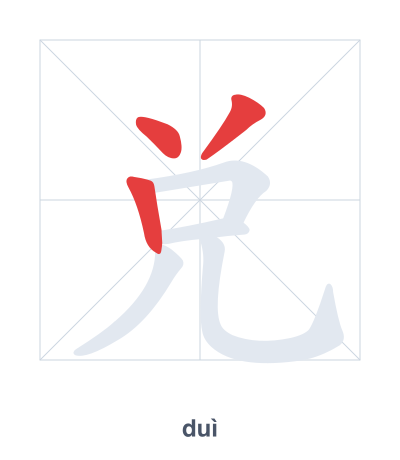
Open Hanzi Writer to see the animated stroke order and practice writing 兑 with real-time feedback.
The character 兑 (duì) is written with 7 strokes. Follow the standard Chinese stroke order: top to bottom, left to right, outside before inside. The radical 儿 is one of its key components.
Practice the correct stroke order with the Hanzi Writer app to see animated stroke-by-stroke guidance with real-time feedback.
兑 means to exchange, to convert.
As an HSK Level 7 character, 兑 is an intermediate-level character.
兑 is a compound character that originally meant 'to exchange.' It combines 八 (eight, also meaning 'to divide') on top and 兄 (elder brother) below, suggesting the act of dividing something with a brother—hence exchanging goods. Over time, the character's form simplified to the modern 兑 while retaining the exchange meaning.
💡 Memory Tip: Picture an elder brother (兄) dividing eight coins (八) to exchange with his younger sibling.
我想兑换一些人民币。
wǒ xiǎng duì huàn yī xiē rén mín bì
I want to exchange some RMB.
他兑现了诺言。
tā duì xiàn le nuò yán
He fulfilled his promise.
银行可以办理汇兑。
yín háng kě yǐ bàn lǐ huì duì
Banks can process remittances.
Open Hanzi Writer to see the animated stroke order and practice writing 兑 with real-time feedback.
✨ Animated stroke order · Handwriting recognition · HSK-graded practice · Free to use
兑 is made of three parts: the top 丷 (eight), middle 口 (mouth), and bottom 儿 (legs). This combination suggests the idea of splitting or transforming something through speech or movement, linking to its meaning of exchange or conversion.