伄 (diào) means "To hang or dangle (archaic)" in Chinese. It has 6 strokes with the radical 亻.
Rated 2.9/5 in difficulty (moderate).
Appears in 3+ common words including 伄挂 (diào guà), 伄然 (diào rán), 伄子 (diào zi).
Hanzi Writer's stroke validation shows learners typically need 5-8 attempts to write 伄 with correct proportion and order.
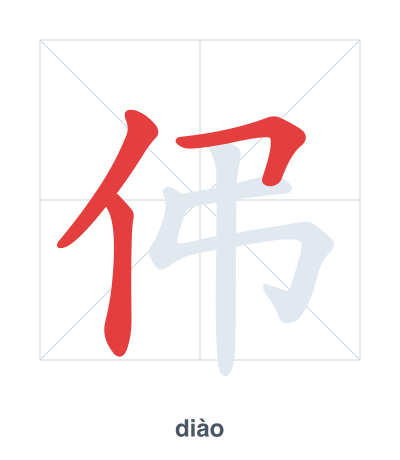
Open Hanzi Writer to see the animated stroke order and practice writing 伄 with real-time feedback.
The character 伄 (diào) is written with 6 strokes. Follow the standard Chinese stroke order: top to bottom, left to right, outside before inside. The radical 亻 is one of its key components.
Practice the correct stroke order with the Hanzi Writer app to see animated stroke-by-stroke guidance with real-time feedback.
伄 means To hang or dangle (archaic).
伄 combines the person radical 亻 with 弔, where 弔 originally depicted a person hanging from a rope, together reinforcing the idea of a person dangling.
💡 Memory Tip: Picture a person (亻) with a hook (弔) caught in their collar, leaving them dangling in midair.
东西在伄挂着。
dōng xī zài diào guà zhe
The thing is hanging.
他伄然独立。
tā diào rán dú lì
He stands alone.
这是一个伄子。
zhè shì yí gè diào zi
This is a 'diaozi' (a rare term for a type of person or object).
Open Hanzi Writer to see the animated stroke order and practice writing 伄 with real-time feedback.
✨ Animated stroke order · Handwriting recognition · HSK-graded practice · Free to use
伄 is composed of the radical 亻 (person) on the left and 吊 (diào, to hang) on the right. The 亻 indicates a person performing an action, while 吊 gives both the pronunciation and the core idea of hanging or dangling. Together they form a character meaning 'to hang or dangle' in an archaic sense.