碲 (dì) means "Tellurium (chemical element)" in Chinese. It has 14 strokes with the radical 石.
Rated 4.2/5 in difficulty (advanced).
Appears in 3+ common words including 碲化物 (dì huà wù), 碲元素 (dì yuán sù), 碲矿 (dì kuàng).
Due to its 14 strokes, Hanzi Writer's error detection shows 碲 requires focused practice — most learners need 10+ attempts for consistent accuracy.
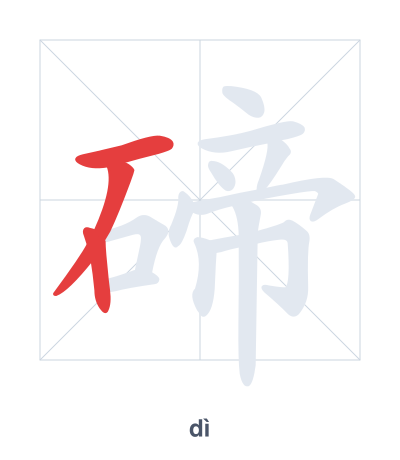
Open Hanzi Writer to see the animated stroke order and practice writing 碲 with real-time feedback.
The character 碲 (dì) is written with 14 strokes. Follow the standard Chinese stroke order: top to bottom, left to right, outside before inside. The radical 石 is one of its key components.
Practice the correct stroke order with the Hanzi Writer app to see animated stroke-by-stroke guidance with real-time feedback.
碲 means Tellurium (chemical element).
碲 is a phono-semantic compound. The radical 石 (stone) indicates it is a mineral or element, while 帝 (emperor, pronounced dì) supplies the sound. Its meaning as 'tellurium' was assigned when modern chemistry adopted this character for the element, which is often found in mineral ores.
💡 Memory Tip: Imagine a stone (石) fit for an emperor (帝) because it contains the rare element tellurium.
实验室里有碲化物。
shí yàn shì lǐ yǒu dì huà wù
There are tellurides in the laboratory.
碲元素很有用。
dì yuán sù hěn yǒu yòng
Tellurium is very useful.
这里发现了一个碲矿。
zhè lǐ fā xiàn le yí gè dì kuàng
A tellurium mine was discovered here.
Open Hanzi Writer to see the animated stroke order and practice writing 碲 with real-time feedback.
✨ Animated stroke order · Handwriting recognition · HSK-graded practice · Free to use
碲 is formed from the radical 石 (stone, rock) on the left and the phonetic component 帝 (dì) on the right. The radical 石 indicates that tellurium is a mineral-like substance found in ores. The right side 帝 only provides the pronunciation, not the meaning.