眚 (shěng) means "cataract; error; disaster" in Chinese. It has 10 strokes with the radical 目.
Rated 4.2/5 in difficulty (advanced).
Appears in 3+ common words including 眚灾 (shěng zāi), 灾眚 (zāi shěng), 眚目 (shěng mù).
Due to its 10 strokes, Hanzi Writer's error detection shows 眚 requires focused practice — most learners need 10+ attempts for consistent accuracy.
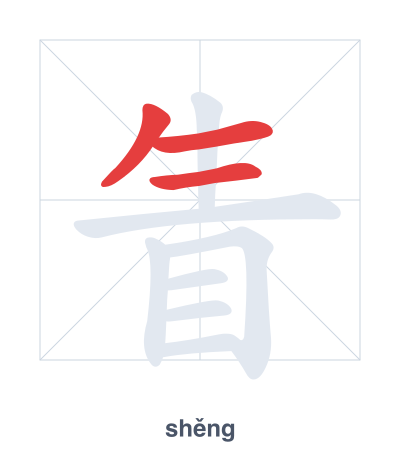
Open Hanzi Writer to see the animated stroke order and practice writing 眚 with real-time feedback.
The character 眚 (shěng) is written with 10 strokes. Follow the standard Chinese stroke order: top to bottom, left to right, outside before inside. The radical 目 is one of its key components.
Practice the correct stroke order with the Hanzi Writer app to see animated stroke-by-stroke guidance with real-time feedback.
眚 means cataract; error; disaster.
眚 combines 目 (eye) and 生 (birth/growth), indicating something that grows on the eye—a cataract or visual defect. It also extends metaphorically to mean 'error' or 'disaster' as an affliction or flaw.
💡 Memory Tip: Imagine a cataract growing like a 'birthmark' on your eye (目) that suddenly 'sprouts' (生) into a blinding disaster—yikes!
这是一个眚灾。
zhè shì yí gè shěng zāi
This is a natural disaster.
我们要避免灾眚。
wǒ men yào bì miǎn zāi shěng
We must avoid disasters.
他的眚目已经好了。
tā de shěng mù yǐ jīng hǎo le
His eye ailment has healed.
Open Hanzi Writer to see the animated stroke order and practice writing 眚 with real-time feedback.
✨ Animated stroke order · Handwriting recognition · HSK-graded practice · Free to use
眚 is composed of two parts: the top part 生 (shēng, meaning 'life' or 'birth') and the bottom radical 目 (mù, meaning 'eye'). The combination suggests an eye condition like a cataract that affects vision, linking to its meanings of eye disease, error, or disaster.