戥 (děng) means "A small steelyard for weighing precision items." in Chinese. It has 13 strokes with the radical 戈.
Rated 4.2/5 in difficulty (advanced).
Appears in 3+ common words including 戥子 (děng zi), 戥秤 (děng chèng), 戥金 (děng jīn).
Due to its 13 strokes, Hanzi Writer's error detection shows 戥 requires focused practice — most learners need 10+ attempts for consistent accuracy.
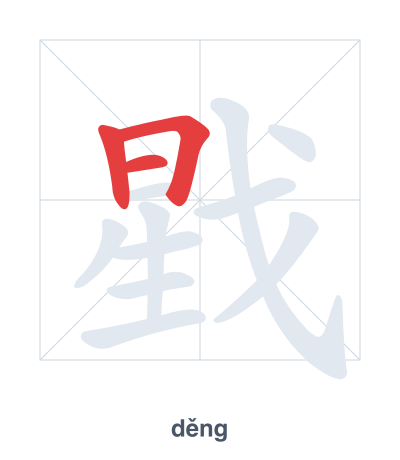
Open Hanzi Writer to see the animated stroke order and practice writing 戥 with real-time feedback.
The character 戥 (děng) is written with 13 strokes. Follow the standard Chinese stroke order: top to bottom, left to right, outside before inside. The radical 戈 is one of its key components.
Practice the correct stroke order with the Hanzi Writer app to see animated stroke-by-stroke guidance with real-time feedback.
戥 means A small steelyard for weighing precision items..
戥 is a compound character: 等 (děng, 'equal, balance') provides the sound and the idea of equilibrium, while 戈 (dagger-axe) depicts the beam of a small steelyard—the weapon-like shape resembling the balance arm used for weighing precious items precisely.
💡 Memory Tip: Picture a tiny steelyard shaped like a dagger (戈) carefully weighing equal amounts (等) of gold dust at a temple.
医生在用戥子称药。
yī shēng zài yòng děng zi chēng yào
The doctor is weighing medicine with a small steelyard.
这把戥秤非常准。
zhè bǎ děng chèng fēi cháng zhǔn
This small steelyard scale is very accurate.
他用戥子称金子。
tā yòng děng zi chēng jīn zi
He used a small steelyard to weigh the gold.
Open Hanzi Writer to see the animated stroke order and practice writing 戥 with real-time feedback.
✨ Animated stroke order · Handwriting recognition · HSK-graded practice · Free to use
戥 is made of 戈 (a weapon or spear) on the left and 戉 (a battle axe) on the right, but these radicals don't directly describe weighing. Instead, the character's design comes from its use as a precision instrument; the left side 戈 represents a small hook, and the right side 戉 suggests a metal weight, combining to show the function of a small steelyard.