怛 (dá) means "distressed; anxious" in Chinese. It has 8 strokes with the radical 忄.
Rated 3.7/5 in difficulty (challenging).
Appears in 3+ common words including 惨怛 (cǎn dá), 怛然 (dá rán), 怛伤 (dá shāng).
Due to its 8 strokes, Hanzi Writer's error detection shows 怛 requires focused practice — most learners need 10+ attempts for consistent accuracy.
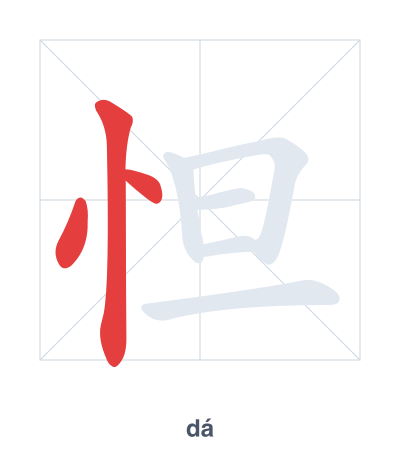
Open Hanzi Writer to see the animated stroke order and practice writing 怛 with real-time feedback.
The character 怛 (dá) is written with 8 strokes. Follow the standard Chinese stroke order: top to bottom, left to right, outside before inside. The radical 忄 is one of its key components.
Practice the correct stroke order with the Hanzi Writer app to see animated stroke-by-stroke guidance with real-time feedback.
怛 means distressed; anxious.
怛 is a phono-semantic compound where the radical 忄 (heart) conveys emotion, and 旦 (dawn) primarily provides the phonetic hint. The character visually ties emotional distress to the heart, perhaps suggesting an anxious state as day breaks.
💡 Memory Tip: Picture your heart (忄) stuck at dawn (旦), dreading the day ahead with a deep sense of distress.
他的遭遇令人惨怛。
tā de zāo yù lìng rén cǎn dá
His experience is heart-wrenching.
闻此消息,怛然失色。
wén cǐ xiāo xī dá rán shī sè
Hearing this news, he turned pale with shock.
他的内心感到怛伤。
tā de nèi xīn gǎn dào dá shāng
He feels distressed in his heart.
Open Hanzi Writer to see the animated stroke order and practice writing 怛 with real-time feedback.
✨ Animated stroke order · Handwriting recognition · HSK-graded practice · Free to use
怛 is made of two parts: the left radical 忄 (xīn, heart) and the right part 旦 (dàn, dawn). The heart radical indicates that the character relates to emotions, while 旦 provides the pronunciation (dá) and does not directly relate to the meaning of being distressed or anxious.