萃 (cuì) means "gather; assemble; elite" in Chinese. It has 11 strokes with the radical 艹.
Rated 4.2/5 in difficulty (advanced).
Appears in 3+ common words including 荟萃 (huì cuì), 出类拔萃 (chū lèi bá cuì), 精萃 (jīng cuì).
Due to its 11 strokes, Hanzi Writer's error detection shows 萃 requires focused practice — most learners need 10+ attempts for consistent accuracy.
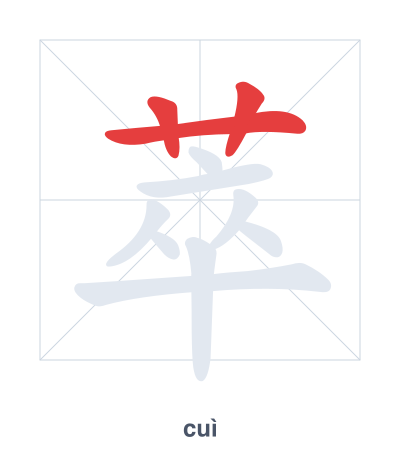
Open Hanzi Writer to see the animated stroke order and practice writing 萃 with real-time feedback.
The character 萃 (cuì) is written with 11 strokes. Follow the standard Chinese stroke order: top to bottom, left to right, outside before inside. The radical 艹 is one of its key components.
Practice the correct stroke order with the Hanzi Writer app to see animated stroke-by-stroke guidance with real-time feedback.
萃 means gather; assemble; elite.
萃 combines 艹 (grass) and 卒 (soldier). Originally it depicted lush grass growing densely together, later extended to mean 'to gather' or 'assemble'—like soldiers mustering under cover of vegetation, or elite talents collected like a thicket of fine plants.
💡 Memory Tip: Imagine a grass (艹) soldier (卒) calling his troops to assemble in the tall grass for an elite mission.
这里人才荟萃。
zhè lǐ rén cái huì cuì
This place is a gathering of talented people.
他的表现出类拔萃。
tā de biǎo xiàn chū lèi bá cuì
His performance was outstanding.
这是文化的精萃。
zhè shì wén huà de jīng cuì
This is the quintessence of culture.
Open Hanzi Writer to see the animated stroke order and practice writing 萃 with real-time feedback.
✨ Animated stroke order · Handwriting recognition · HSK-graded practice · Free to use
萃 has two parts: the top is 艹 (grass radical) and the bottom is 卒 (soldier). Together they suggest grass growing together in a group, which relates to the meanings of "gather" and "assemble". The bottom part also hints at the pronunciation cuì.