骢 (cōng) means "piebald horse" in Chinese. It has 14 strokes with the radical 马.
Rated 4.2/5 in difficulty (advanced).
Appears in 3+ common words including 青骢马 (qīng cōng mǎ), 骢马 (cōng mǎ), 乌骢 (wū cōng).
Due to its 14 strokes, Hanzi Writer's error detection shows 骢 requires focused practice — most learners need 10+ attempts for consistent accuracy.
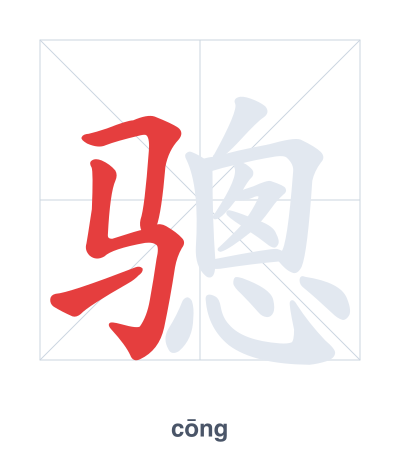
Open Hanzi Writer to see the animated stroke order and practice writing 骢 with real-time feedback.
The character 骢 (cōng) is written with 14 strokes. Follow the standard Chinese stroke order: top to bottom, left to right, outside before inside. The radical 马 is one of its key components.
Practice the correct stroke order with the Hanzi Writer app to see animated stroke-by-stroke guidance with real-time feedback.
骢 means piebald horse.
This compound character combines the radical 马 (horse) with the phonetic component 悤 (cōng). The horse radical directly relates to the meaning of a horse, while the phonetic component hints at the pronunciation. A 骢 specifically refers to a piebald horse with splotches of different colors.
💡 Memory Tip: Picture a horse (马) with a chaotic pattern of spots that makes you say 'cōng' as you try to count them all—like a messy 'con-fetti' horse.
青骢马非常漂亮。
qīng cōng mǎ fēi cháng piào liàng
The dappled gray horse is very beautiful.
骢马在草原上奔跑。
cōng mǎ zài cǎo yuán shàng bēn pǎo
The dappled horse is running on the grassland.
乌骢是名贵的马种。
wū cōng shì míng guì de mǎ zhǒng
The dark piebald horse is a precious breed.
Open Hanzi Writer to see the animated stroke order and practice writing 骢 with real-time feedback.
✨ Animated stroke order · Handwriting recognition · HSK-graded practice · Free to use
骢 is a left-right character. The left radical 马 (horse) indicates the meaning relates to horses, while the right part 悤 (cōng, which contains 囗 and 心) provides the sound and is not directly related to meaning. Together, 骢 specifically means a piebald or dappled horse.