祠 (cí) means "Ancestral hall; shrine" in Chinese. It has 9 strokes with the radical 礻.
Rated 4/5 in difficulty (challenging).
Appears in 3+ common words including 祠堂 (cí táng), 宗祠 (zōng cí), 祖祠 (zǔ cí).
Due to its 9 strokes, Hanzi Writer's error detection shows 祠 requires focused practice — most learners need 10+ attempts for consistent accuracy.
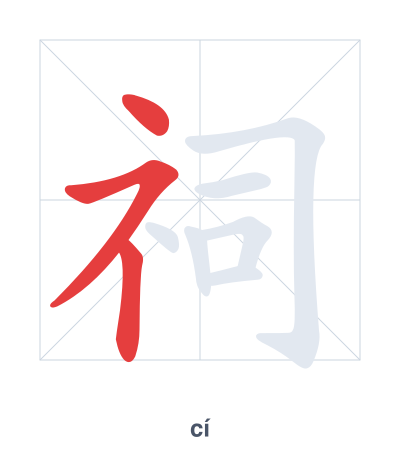
Open Hanzi Writer to see the animated stroke order and practice writing 祠 with real-time feedback.
The character 祠 (cí) is written with 9 strokes. Follow the standard Chinese stroke order: top to bottom, left to right, outside before inside. The radical 礻 is one of its key components.
Practice the correct stroke order with the Hanzi Writer app to see animated stroke-by-stroke guidance with real-time feedback.
祠 means Ancestral hall; shrine.
祠 combines the radical 礻 (示), meaning 'spirit' or 'altar', with 司 (sī), which originally meant 'to manage' or 'preside over'. The character thus depicts a place where spirits are managed or officiated—an ancestral hall or shrine for worship and rituals.
💡 Memory Tip: Picture a shrine where a manager in a suit (司) stands next to an altar (礻), directing ghostly ancestors to their proper seats.
我们去参观祠堂。
wǒ men qù cān guān cí táng
We are going to visit the ancestral hall.
这是王家的宗祠。
zhè shì wáng jiā de zōng cí
This is the Wang family's ancestral hall.
祖祠每年都开放。
zǔ cí měi nián dōu kāi fàng
The ancestral hall is open every year.
Open Hanzi Writer to see the animated stroke order and practice writing 祠 with real-time feedback.
✨ Animated stroke order · Handwriting recognition · HSK-graded practice · Free to use
祠 is made of the radical 礻 (altar) on the left, and 司 (to manage) on the right. The radical 礻 connects to spirits or offerings, while 司 suggests a place where ancestral rites are managed. Together, they form the idea of a hall dedicated to honoring and managing ancestral spirits.