惙 (chuò) means "Sad" in Chinese. It has 11 strokes with the radical 忄.
Rated 4.2/5 in difficulty (advanced).
Appears in 3+ common words including 忧惙 (yōu chuò), 惙惙 (chuò chuò), 惙然 (chuò rán).
Due to its 11 strokes, Hanzi Writer's error detection shows 惙 requires focused practice — most learners need 10+ attempts for consistent accuracy.
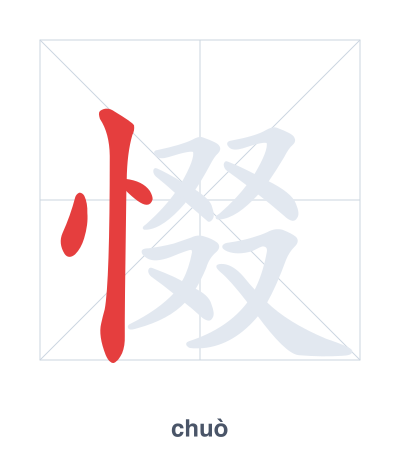
Open Hanzi Writer to see the animated stroke order and practice writing 惙 with real-time feedback.
The character 惙 (chuò) is written with 11 strokes. Follow the standard Chinese stroke order: top to bottom, left to right, outside before inside. The radical 忄 is one of its key components.
Practice the correct stroke order with the Hanzi Writer app to see animated stroke-by-stroke guidance with real-time feedback.
惙 means Sad.
惙 combines the heart radical (忄) with 叕 (chuò), which originally depicted a thread being sewn or tied. The heart tangled or bound by sorrow reflects the character's meaning of sadness or grief.
💡 Memory Tip: Imagine a heart (忄) tied up with four knots (like the four '又' in 叕), making it feel sad and trapped.
他整天忧惙不安。
tā zhěng tiān yōu chuò bù ān
He is worried and restless all day long.
他的心跳惙惙。
tā de xīn tiào chuò chuò
His heart was thumping with anxiety.
他惙然若失。
tā chuò rán ruò shī
He felt dejected and lost.
Open Hanzi Writer to see the animated stroke order and practice writing 惙 with real-time feedback.
✨ Animated stroke order · Handwriting recognition · HSK-graded practice · Free to use
惙 has the radical 忄 (heart) on the left, which indicates an emotion. The right side is 叕, which originally meant "to connect" or "to tie up," and together they suggest a heart feeling tied up or trapped, leading to sadness and anxiety.