椿 (chūn) means "Chinese toon" in Chinese. It has 13 strokes with the radical 木.
Rated 4.2/5 in difficulty (advanced).
Appears in 3+ common words including 香椿 (xiāng chūn), 椿芽 (chūn yá), 椿树 (chūn shù).
Due to its 13 strokes, Hanzi Writer's error detection shows 椿 requires focused practice — most learners need 10+ attempts for consistent accuracy.
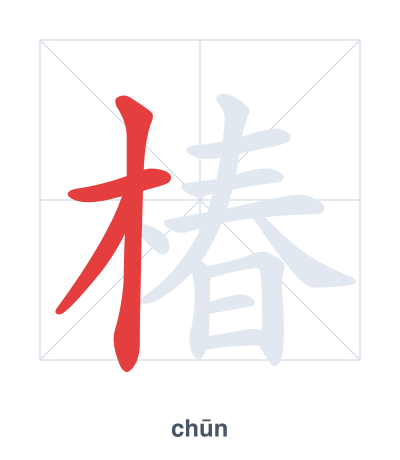
Open Hanzi Writer to see the animated stroke order and practice writing 椿 with real-time feedback.
The character 椿 (chūn) is written with 13 strokes. Follow the standard Chinese stroke order: top to bottom, left to right, outside before inside. The radical 木 is one of its key components.
Practice the correct stroke order with the Hanzi Writer app to see animated stroke-by-stroke guidance with real-time feedback.
椿 means Chinese toon.
椿 is a compound character with the tree radical 木 indicating it's a type of tree, and 春 (spring) as the phonetic component, suggesting this tree is associated with spring—the Chinese toon (Toona sinensis) is known for its tender spring leaves eaten as a vegetable.
💡 Memory Tip: Imagine a tree (木) bursting with fresh growth in spring (春), its fragrant toon leaves ready to be picked and stir-fried.
妈妈做了香椿炒鸡蛋。
mā mā zuò le xiāng chūn chǎo jī dàn
Mom made scrambled eggs with toon sprouts.
春天可以吃椿芽。
chūn tiān kě yǐ chī chūn yá
You can eat Chinese mahogany sprouts in spring.
院子里种了一棵椿树。
yuàn zi lǐ zhǒng le yī kē chūn shù
A Chinese toon tree is planted in the yard.
Open Hanzi Writer to see the animated stroke order and practice writing 椿 with real-time feedback.
✨ Animated stroke order · Handwriting recognition · HSK-graded practice · Free to use
椿 is made of two parts: the left radical 木 (wood/tree) and the right part 春 (spring). Since 椿 refers to a type of tree (the Chinese toon), the 木 component shows it is a tree. The 春 part may hint that the tree's edible sprouts appear in spring.