搐 (chù) means "to twitch; to convulse" in Chinese. It has 13 strokes with the radical 扌.
Rated 4.2/5 in difficulty (advanced).
Appears in 3+ common words including 抽搐 (chōu chù), 搐动 (chù dòng), 搐鼻 (chù bí).
Due to its 13 strokes, Hanzi Writer's error detection shows 搐 requires focused practice — most learners need 10+ attempts for consistent accuracy.
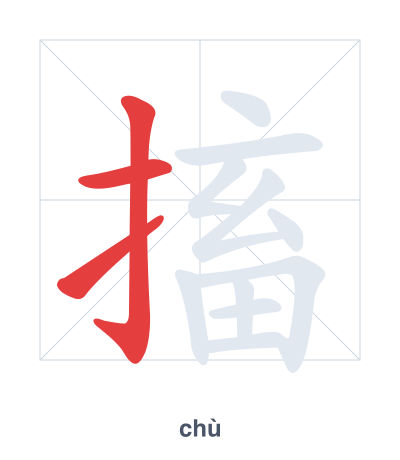
Open Hanzi Writer to see the animated stroke order and practice writing 搐 with real-time feedback.
The character 搐 (chù) is written with 13 strokes. Follow the standard Chinese stroke order: top to bottom, left to right, outside before inside. The radical 扌 is one of its key components.
Practice the correct stroke order with the Hanzi Writer app to see animated stroke-by-stroke guidance with real-time feedback.
搐 means to twitch; to convulse.
The character 搐 is a phono-semantic compound: the hand radical 扌 hints at a physical action, while 畜 (chù, meaning 'livestock') provides the pronunciation and may suggest the jerky, involuntary movements of frightened or sick animals.
💡 Memory Tip: Imagine a hand (扌) trying to hold onto a convulsing pig (畜) that keeps twitching and shaking uncontrollably.
他的手在不停地抽搐。
tā de shǒu zài bù tíng dì chōu chù
His hand is twitching constantly.
他的嘴角微微搐动了一下。
tā de zuǐ jiǎo wēi wēi chù dòng le yī xià
The corner of his mouth twitched slightly.
他难受得直搐鼻子。
tā nán shòu dé zhí chù bí zi
He was so uncomfortable that his nose kept twitching.
Open Hanzi Writer to see the animated stroke order and practice writing 搐 with real-time feedback.
✨ Animated stroke order · Handwriting recognition · HSK-graded practice · Free to use
The left radical 扌 (hand) indicates the character involves hand or body movement. The right part 畜 (chù, livestock or to raise) provides pronunciation and may suggest an animal-like jerking motion. Together, 搐 means involuntary muscle movements like twitching or convulsing.