焯 (chāo) means "to blanch" in Chinese. It has 12 strokes with the radical 火.
Rated 4.2/5 in difficulty (advanced).
Appears in 3+ common words including 焯水 (chāo shuǐ), 焯菜 (chāo cài), 焯熟 (chāo shú).
Due to its 12 strokes, Hanzi Writer's error detection shows 焯 requires focused practice — most learners need 10+ attempts for consistent accuracy.
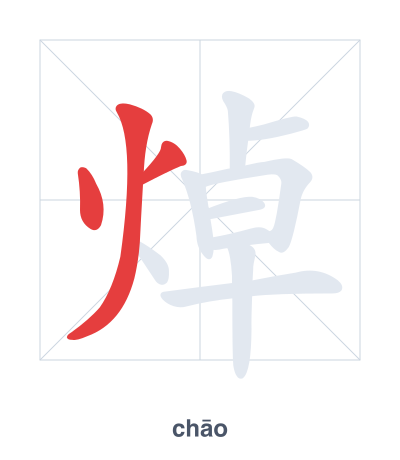
Open Hanzi Writer to see the animated stroke order and practice writing 焯 with real-time feedback.
The character 焯 (chāo) is written with 12 strokes. Follow the standard Chinese stroke order: top to bottom, left to right, outside before inside. The radical 火 is one of its key components.
Practice the correct stroke order with the Hanzi Writer app to see animated stroke-by-stroke guidance with real-time feedback.
焯 means to blanch.
焯 combines the fire radical 火 (heat) with 卓 (zhuó), which provides pronunciation and may hint at 'raising' the food out quickly. The character depicts the action of briefly immersing ingredients in boiling water to scald or blanch them.
💡 Memory Tip: Picture a cook holding a colander over a fire (火) and 卓 (a tall stand) as they quickly dip veggies into boiling water to blanch them.
把肉焯一下水。
bǎ ròu chāo yī xià shuǐ
Blanch the meat.
蔬菜要先焯水。
shū cài yào xiān chāo shuǐ
The vegetables need to be blanched first.
把虾焯熟即可。
bǎ xiā chāo shú jí kě
Just blanch the shrimp until cooked.
Open Hanzi Writer to see the animated stroke order and practice writing 焯 with real-time feedback.
✨ Animated stroke order · Handwriting recognition · HSK-graded practice · Free to use
焯 is made of the radical 火 (fire) on the left and 卓 on the right. The 火 radical shows that the action involves heat, while 卓 gives the sound and hints at the quick, outstanding effect of blanching food.