镡 (chán) means "sword guard" in Chinese. It has 17 strokes with the radical 钅.
Rated 4.2/5 in difficulty (advanced).
Appears in 3+ common words including 剑镡 (jiàn chán), 刀镡 (dāo chán), 铜镡 (tóng chán).
Due to its 17 strokes, Hanzi Writer's error detection shows 镡 requires focused practice — most learners need 10+ attempts for consistent accuracy.
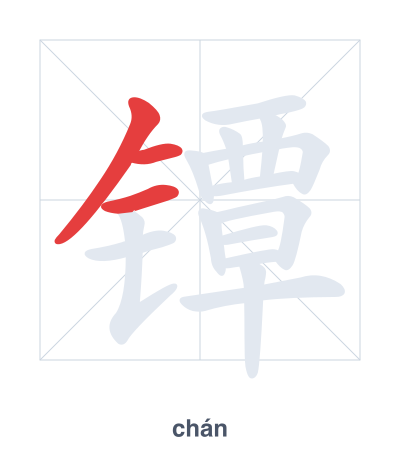
Open Hanzi Writer to see the animated stroke order and practice writing 镡 with real-time feedback.
The character 镡 (chán) is written with 17 strokes. Follow the standard Chinese stroke order: top to bottom, left to right, outside before inside. The radical 钅 is one of its key components.
Practice the correct stroke order with the Hanzi Writer app to see animated stroke-by-stroke guidance with real-time feedback.
镡 means sword guard.
镡 is a phono-semantic compound. The radical 钅 (metal) shows the sword guard is made of metal, while 覃 (tán, 'deep') provides a phonetic clue. Together they depict the metal piece that separates the blade from the hilt.
💡 Memory Tip: Picture a metal guard (钅) so deep (覃) it looks like a tanned leather shield blocking the sword's blade.
这把剑的剑镡很美。
zhè bǎ jiàn de jiàn chán hěn měi
The handguard of this sword is very beautiful.
刀镡保护了手指。
dāo chán bǎo hù le shǒu zhǐ
The sword guard protected the fingers.
这是一个古代铜镡。
zhè shì yí gè gǔ dài tóng chán
This is an ancient bronze sword guard.
Open Hanzi Writer to see the animated stroke order and practice writing 镡 with real-time feedback.
✨ Animated stroke order · Handwriting recognition · HSK-graded practice · Free to use
镡 has the metal radical 钅 on the left, which tells you it is a metal object. The right side 覃 gives the pronunciation chán and may hint at the function of covering or protecting, as a sword guard sits between the blade and handle.