虿 (chài) means "Scorpion (archaic)" in Chinese. It has 9 strokes with the radical 虫.
Rated 4/5 in difficulty (challenging).
Appears in 3+ common words including 虿盆 (chài pén), 蜂虿 (fēng chài), 虿尾 (chài wěi).
Due to its 9 strokes, Hanzi Writer's error detection shows 虿 requires focused practice — most learners need 10+ attempts for consistent accuracy.
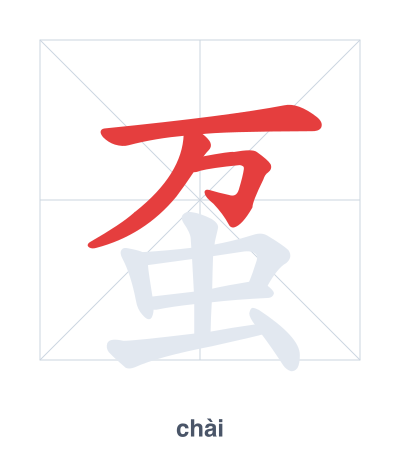
Open Hanzi Writer to see the animated stroke order and practice writing 虿 with real-time feedback.
The character 虿 (chài) is written with 9 strokes. Follow the standard Chinese stroke order: top to bottom, left to right, outside before inside. The radical 虫 is one of its key components.
Practice the correct stroke order with the Hanzi Writer app to see animated stroke-by-stroke guidance with real-time feedback.
虿 means Scorpion (archaic).
The character 虿 originated as a pictograph of a scorpion; its ancient form 萬 showed a curved tail and pincers. Over time, the scorpion shape was simplified in 虿, and the radical 虫 (insect/creature) was added to clarify its meaning.
💡 Memory Tip: Picture the top part as the scorpion's pincers and segmented body, with the bottom 虫 representing the venomous tail curled to strike.
这是一个古老的故事。
zhè shì yí gè gǔ lǎo de gù shì
This is an ancient story.
蜂虿会伤人。
fēng chài huì shāng rén
Venomous insects can hurt people.
虿尾有毒。
chài wěi yǒu dú
The scorpion's tail is poisonous.
Open Hanzi Writer to see the animated stroke order and practice writing 虿 with real-time feedback.
✨ Animated stroke order · Handwriting recognition · HSK-graded practice · Free to use
虿 is made of two parts: the insect radical 虫 on the bottom and the phonetic component 万 (wàn) on top. The radical 虫 tells you it is a type of insect or creature, which matches its meaning of 'scorpion'. The top part 万 provides a hint for pronunciation.