鬓 (bìn) means "sideburns; hair on the temples" in Chinese. It has 20 strokes with the radical 髟.
Rated 4.2/5 in difficulty (advanced).
Appears in 3+ common words including 鬓角 (bìn jiǎo), 鬓发 (bìn fà), 两鬓 (liǎng bìn).
Due to its 20 strokes, Hanzi Writer's error detection shows 鬓 requires focused practice — most learners need 10+ attempts for consistent accuracy.
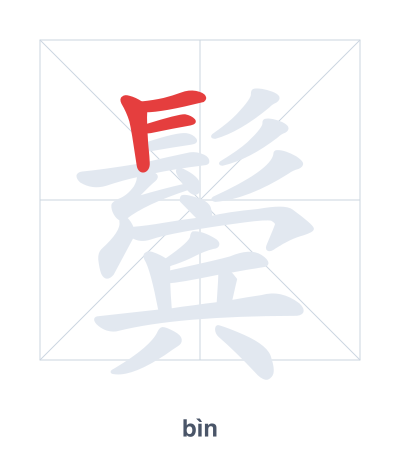
Open Hanzi Writer to see the animated stroke order and practice writing 鬓 with real-time feedback.
The character 鬓 (bìn) is written with 20 strokes. Follow the standard Chinese stroke order: top to bottom, left to right, outside before inside. The radical 髟 is one of its key components.
Practice the correct stroke order with the Hanzi Writer app to see animated stroke-by-stroke guidance with real-time feedback.
鬓 means sideburns; hair on the temples.
| Character | 鬓 |
| Pinyin | bìn (bin) |
| Meaning | sideburns; hair on the temples |
| Strokes | 20 |
| Radical | 髟 |
| Difficulty | 4.2/5 |
鬓 is a compound character with the radical 髟 (long hair) and the phonetic component 賓 (bīn, meaning 'guest'). The radical indicates that the character relates to hair, specifically the hair on the temples or sideburns, while the phonetic provides a clue to the pronunciation. In ancient Chinese, sideburns were often considered a distinctive feature of a visitor or guest, hence the combination.
💡 Memory Tip: Picture a guest (宾) with wild, flowing hair (髟) that frames their face in long sideburns curling down to the jaw.
他的鬓角白了。
tā de bìn jiǎo bái le
His sideburns have turned white.
鬓发随风飘动。
bìn fà suí fēng piāo dòng
The hair on the temples flutters in the wind.
他已两鬓苍苍。
tā yǐ liǎng bìn cāng cāng
His hair at the temples has turned grey.
Open Hanzi Writer to see the animated stroke order and practice writing 鬓 with real-time feedback.
✨ Animated stroke order · Handwriting recognition · HSK-graded practice · Free to use
The character 鬓 has two parts: the top radical 髟 (meaning hair) and the bottom component 宾 (which provides the pronunciation bìn). Together, 髟 indicates that the word is related to hair, while 宾 adds sound, so the whole character refers to the hair on the temples or sideburns.