缏 (biàn) means "braid / to braid" in Chinese. It has 12 strokes with the radical 纟.
Rated 4.2/5 in difficulty (advanced).
Appears in 3+ common words including 发缏 (fā biàn), 缏子 (biàn zi), 草缏 (cǎo biàn).
Due to its 12 strokes, Hanzi Writer's error detection shows 缏 requires focused practice — most learners need 10+ attempts for consistent accuracy.
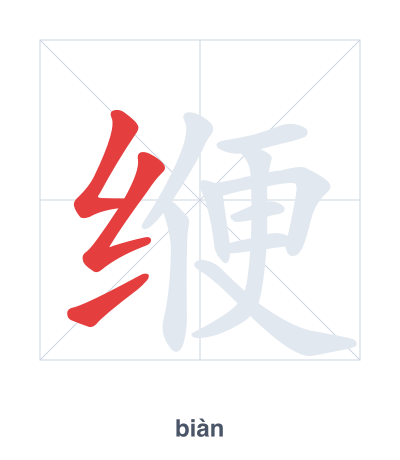
Open Hanzi Writer to see the animated stroke order and practice writing 缏 with real-time feedback.
The character 缏 (biàn) is written with 12 strokes. Follow the standard Chinese stroke order: top to bottom, left to right, outside before inside. The radical 纟 is one of its key components.
Practice the correct stroke order with the Hanzi Writer app to see animated stroke-by-stroke guidance with real-time feedback.
缏 means braid / to braid.
缏 is a compound character with the radical 纟 (silk) showing it relates to threads or fabric, and the phonetic component 便 (biàn, meaning 'convenient') hinting at its pronunciation. It specifically refers to braiding or plaiting silk or other fibers together.
💡 Memory Tip: Imagine a skilled weaver using silk threads (纟) to braid a rope so neatly that it becomes 'convenient' (便) to carry.
她的发缏扎得很整齐。
tā de fā biàn zhā dé hěn zhěng qí
Her braids are tied very neatly.
小女孩垂着两条缏子。
xiǎo nǚ hái chuí zhe liǎng tiáo biàn zi
The little girl has two braids hanging down.
他在编一个草缏。
tā zài biān yí gè cǎo biàn
He is weaving a straw braid.
Open Hanzi Writer to see the animated stroke order and practice writing 缏 with real-time feedback.
✨ Animated stroke order · Handwriting recognition · HSK-graded practice · Free to use
The character 缏 combines the radical 纟 (silk thread) on the left with 扁 (biǎn, meaning flat) on the right. The silk radical shows this character relates to textiles or weaving, while 扁 hints at the flat shape of a braid or plait. Together, they suggest the idea of braiding threads into a flat strip.