埲 (běng) means "dust / cloud of dust" in Chinese. It has 11 strokes with the radical 土.
Rated 4.2/5 in difficulty (advanced).
Appears in 3+ common words including 埲土 (běng tǔ), 尘埲 (chén běng), 埲子 (běng zi).
Due to its 11 strokes, Hanzi Writer's error detection shows 埲 requires focused practice — most learners need 10+ attempts for consistent accuracy.
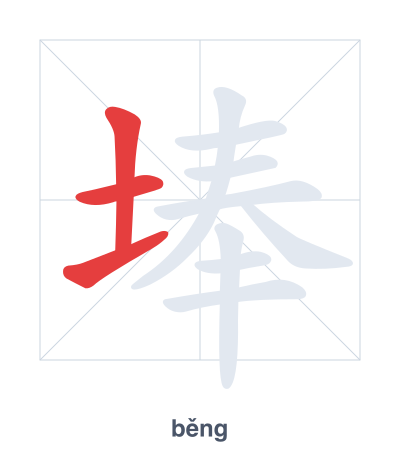
Open Hanzi Writer to see the animated stroke order and practice writing 埲 with real-time feedback.
The character 埲 (běng) is written with 11 strokes. Follow the standard Chinese stroke order: top to bottom, left to right, outside before inside. The radical 土 is one of its key components.
Practice the correct stroke order with the Hanzi Writer app to see animated stroke-by-stroke guidance with real-time feedback.
埲 means dust / cloud of dust.
埲 is a phono-semantic compound character. The radical 土 (earth/ground) hints at the meaning related to dust or earth particles. The right component 奉 (fèng) provides the pronunciation and visually suggests something being offered or raised up, evoking the image of dust being stirred into the air from the ground.
💡 Memory Tip: Picture two hands (the lower part of 奉) scooping up a pile of dirt (土 on the left) and flinging it into the air, creating a thick cloud of dust (埲).
地上有一堆埲土。
dì shàng yǒu yī duī běng tǔ
There is a pile of loose dust on the ground.
远处尘埲飞扬。
yuǎn chù chén běng fēi yáng
Clouds of dust were flying in the distance.
这是一个小埲子。
zhè shì yí gè xiǎo běng zi
This is a small heap of dust.
Open Hanzi Writer to see the animated stroke order and practice writing 埲 with real-time feedback.
✨ Animated stroke order · Handwriting recognition · HSK-graded practice · Free to use
埲 is composed of the radical 土 (earth) on the left and the component 奉 (fèng) on the right. The radical 土 directly indicates earth or soil, while 奉 mainly provides the sound. Together, they suggest "earth that is loose and rises as dust."