Hanzi Writer

How to Write 呗 (bài/bei) — Meaning “particle indicating obviousness or resignation”

bài/bei 7 strokes Radical: 口

呗 (bài/bei) means "particle indicating obviousness or resignation" in Chinese. It has 7 strokes with the radical 口.

Rated 3.5/5 in difficulty (challenging).

Appears in 2+ common words including 随便呗 (suí biàn bei), 梵呗 (fàn bài).

Due to its 7 strokes, Hanzi Writer's error detection shows 呗 requires focused practice — most learners need 10+ attempts for consistent accuracy.
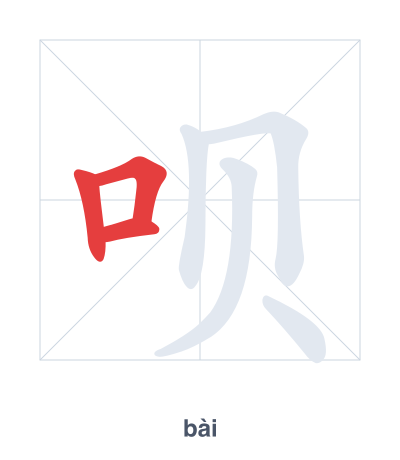
Stroke order practice for 呗 - bài/bei

Practice Writing 呗 (bài/bei)

Open Hanzi Writer to see the animated stroke order and practice writing 呗 with real-time feedback.

The character (bài/bei) is written with 7 strokes. Follow the standard Chinese stroke order: top to bottom, left to right, outside before inside. The radical is one of its key components.

Practice the correct stroke order with the Hanzi Writer app to see animated stroke-by-stroke guidance with real-time feedback.

means particle indicating obviousness or resignation.

This is a polyphonic character with readings: bài, bei.

Character
Pinyinbài / bei (bai/bei)
Meaningparticle indicating obviousness or resignation
Strokes7
Radical
Difficulty3.5/5

呗 is a compound character with the mouth radical 口 ('speech') and the phonetic component 贝 ('shell' or 'treasure'). The mouth indicates that it is a spoken particle, while 贝 provides the sound 'bài' and hints at a casual, dismissive tone—like saying 'obviously' or 'whatever' as if tossing away something trivial as you would a common shell.

💡 Memory Tip: Picture a person opening their mouth (口) to say 'Bai!' while tossing a shell (贝) over their shoulder with a resigned shrug—'Oh well, it's obvious.'

便 suí biàn bei
Whatever; it's up to you.
fàn bài
Buddhist chanting; hymns.

你想吃什么就点什么,我随便呗。

nǐ xiǎng chī shén me jiù diǎn shén me wǒ suí biàn bei

Order whatever you want to eat; I'm fine with anything.

深山古刹里传来了悠扬清净的梵呗声。

shēn shān gǔ chà lǐ chuán lái le yōu yáng qīng jìng de fàn bài shēng

The melodious and pure sound of Buddhist chanting came from the ancient temple deep in the mountains.

Character Pinyin Strokes Radical
(current) bài / bei 7
5
5
gōu / jù 5
Stroke order practice for 呗 - bài/bei

Practice Writing 呗 (bài/bei)

Open Hanzi Writer to see the animated stroke order and practice writing 呗 with real-time feedback.

✨ Animated stroke order · Handwriting recognition · HSK-graded practice · Free to use

Frequently Asked Questions about 呗

呗 is made of two parts: the radical 口 (mouth) on the left, and 贝 (shell/money) on the right. The mouth radical suggests this character is a sound or particle spoken aloud, while 贝 gives the pronunciation bài. Together, they create a character that expresses a tone of voice rather than a concrete object.

Characters with Radical 口

Other 7-Stroke Characters