埯 (ǎn) means "a small pit for seeds / to plant in pits" in Chinese. It has 11 strokes with the radical 土.
Rated 4.2/5 in difficulty (advanced).
Appears in 3+ common words including 埯瓜 (ǎn guā), 挖埯 (wā ǎn), 埯种 (ǎn zhǒng).
Due to its 11 strokes, Hanzi Writer's error detection shows 埯 requires focused practice — most learners need 10+ attempts for consistent accuracy.
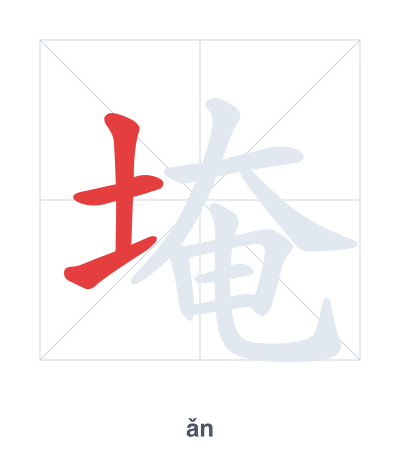
Open Hanzi Writer to see the animated stroke order and practice writing 埯 with real-time feedback.
The character 埯 (ǎn) is written with 11 strokes. Follow the standard Chinese stroke order: top to bottom, left to right, outside before inside. The radical 土 is one of its key components.
Practice the correct stroke order with the Hanzi Writer app to see animated stroke-by-stroke guidance with real-time feedback.
埯 means a small pit for seeds / to plant in pits.
埯 combines the radical 土 (earth) with 奄 (cover), suggesting covering seeds with earth in a small pit. The component 奄 visually implies pressing down or covering over the soil, matching the agricultural action of planting seeds in holes and covering them.
💡 Memory Tip: Picture a farmer digging a small hole (土) and covering it with a lid (奄) to keep the seed safe inside.
农民在田里埯瓜。
nóng mín zài tián lǐ ǎn guā
Farmers are planting melons in pits.
他在地上挖了一个埯。
tā zài dì shàng wā le yí gè ǎn
He dug a small hole in the ground.
这种蔬菜适合埯种。
zhè zhǒng shū cài shì hé ǎn zhǒng
This vegetable is suitable for hill-planting.
Open Hanzi Writer to see the animated stroke order and practice writing 埯 with real-time feedback.
✨ Animated stroke order · Handwriting recognition · HSK-graded practice · Free to use
The character 埯 is made of the radical 土 (earth) on the left and 奄 (yǎn, meaning 'cover' or 'to cover') on the right. The radical 土 indicates that it is related to soil or farming, while 奄 suggests the action of covering seeds with earth. Together, they represent digging a small pit in the soil and planting seeds in it.