娭 (āi) means "grandmother (dialect); to play" in Chinese. It has 10 strokes with the radical 女.
Rated 4.2/5 in difficulty (advanced).
Appears in 3+ common words including 娭毑 (āi jiě), 娭姆 (āi mǔ), 娭戏 (āi xì).
Due to its 10 strokes, Hanzi Writer's error detection shows 娭 requires focused practice — most learners need 10+ attempts for consistent accuracy.
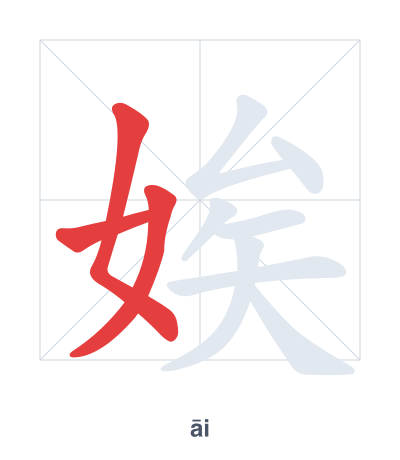
Open Hanzi Writer to see the animated stroke order and practice writing 娭 with real-time feedback.
The character 娭 (āi) is written with 10 strokes. Follow the standard Chinese stroke order: top to bottom, left to right, outside before inside. The radical 女 is one of its key components.
Practice the correct stroke order with the Hanzi Writer app to see animated stroke-by-stroke guidance with real-time feedback.
娭 means grandmother (dialect); to play.
娭 is a phono-semantic compound: the radical 女 (woman) indicates a female role, and the component 矣 (yǐ, a classical particle) provides the sound. In some dialects, it came to mean 'grandmother' (an elder woman) or 'to play' (possibly from an affectionate or playful exclamation).
💡 Memory Tip: Picture a grandmother (女) saying 'Ai!' (矣) as she plays with her grandchild, chasing them around the room.
娭毑在喝茶。
āi jiě zài hē chá
Grandmother is drinking tea.
娭姆很慈祥。
āi mǔ hěn cí xiáng
The grandmother is very kind.
孩子们在娭戏。
hái zi men zài āi xì
The children are playing.
Open Hanzi Writer to see the animated stroke order and practice writing 娭 with real-time feedback.
✨ Animated stroke order · Handwriting recognition · HSK-graded practice · Free to use
娭 is formed with the radical 女 (woman) on the left, indicating a female person. The right part 矣 is a phonetic component suggesting the sound "āi," so the character means "grandmother" (an elder woman) in certain dialects.