滓 (zǐ) means "dregs; residue" in Chinese. It has 13 strokes with the radical 氵.
Rated 4.2/5 in difficulty (advanced).
Appears in 3+ common words including 渣滓 (zhā zǐ), 沉滓 (chén zǐ), 废滓 (fèi zǐ).
Due to its 13 strokes, Hanzi Writer's error detection shows 滓 requires focused practice — most learners need 10+ attempts for consistent accuracy.
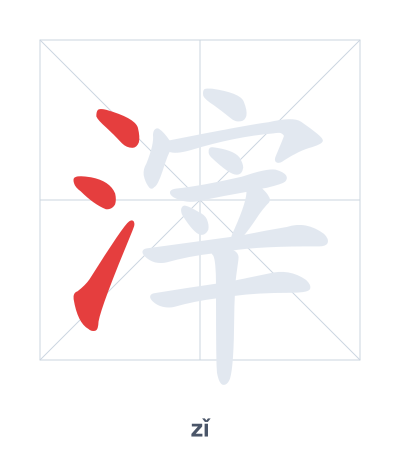
Open Hanzi Writer to see the animated stroke order and practice writing 滓 with real-time feedback.
The character 滓 (zǐ) is written with 13 strokes. Follow the standard Chinese stroke order: top to bottom, left to right, outside before inside. The radical 氵 is one of its key components.
Practice the correct stroke order with the Hanzi Writer app to see animated stroke-by-stroke guidance with real-time feedback.
滓 means dregs; residue.
滓 combines the water radical (氵) with 宰 (zǎi, 'to slaughter' or 'govern') as a phonetic component. The character originally denoted sediment or impurities settling in liquid, like the undesirable residue left behind after a process.
💡 Memory Tip: Picture a butcher (宰) washing off bitter blood and grime into water (氵), leaving behind a murky puddle of dregs.
倒掉这些渣滓。
dào diào zhè xiē zhā zǐ
Dump out these dregs.
水底有沉滓。
shuǐ dǐ yǒu chén zǐ
There is sediment at the bottom of the water.
清理这些废滓。
qīng lǐ zhè xiē fèi zǐ
Clean up these wastes.
Open Hanzi Writer to see the animated stroke order and practice writing 滓 with real-time feedback.
✨ Animated stroke order · Handwriting recognition · HSK-graded practice · Free to use
The character 滓 combines the water radical 氵 on the left with the phonetic component 宰 (zǎi) on the right. The water radical suggests liquid or residue related to water, while 宰 means "to govern" but here acts as a sound hint. Together they form the idea of sediment or dregs that settle out of a liquid.