梓 (zǐ) means "Catalpa tree or printing block" in Chinese. It has 11 strokes with the radical 木.
Rated 4.2/5 in difficulty (advanced).
Appears in 3+ common words including 梓里 (zǐ lǐ), 梓木 (zǐ mù), 桑梓 (sāng zǐ).
Due to its 11 strokes, Hanzi Writer's error detection shows 梓 requires focused practice — most learners need 10+ attempts for consistent accuracy.
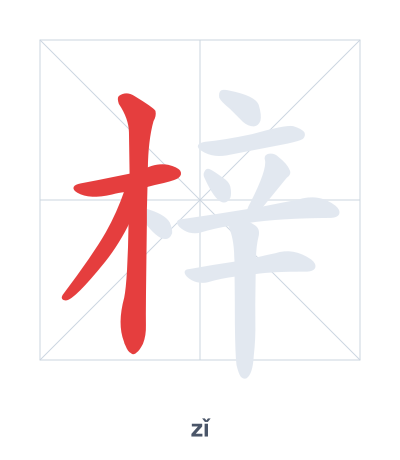
Open Hanzi Writer to see the animated stroke order and practice writing 梓 with real-time feedback.
The character 梓 (zǐ) is written with 11 strokes. Follow the standard Chinese stroke order: top to bottom, left to right, outside before inside. The radical 木 is one of its key components.
Practice the correct stroke order with the Hanzi Writer app to see animated stroke-by-stroke guidance with real-time feedback.
梓 means Catalpa tree or printing block.
梓 is a compound character: the radical 木 (tree) indicates it's a type of tree, while 子 (child) provides the pronunciation zǐ. The catalpa tree's wood was historically used for making printing blocks, giving 梓 its second meaning.
💡 Memory Tip: Picture a child (子) carving their name into a catalpa tree (木) to mark it as the future source of printing blocks.
他回到了梓里。
tā huí dào le zǐ lǐ
He returned to his hometown.
这张桌子是梓木做的。
zhè zhāng zhuō zi shì zǐ mù zuò de
This table is made of catalpa wood.
他非常热爱桑梓。
tā fēi cháng rè ài sāng zǐ
He loves his hometown very much.
Open Hanzi Writer to see the animated stroke order and practice writing 梓 with real-time feedback.
✨ Animated stroke order · Handwriting recognition · HSK-graded practice · Free to use
梓 is a left-right character. The left part 木 means 'tree' and indicates it is a type of tree, the catalpa. The right part 辛 originally represented a chisel or tool used for carving wood, which connects to printing blocks made from catalpa wood.