潴 (zhū) means "to stagnate or accumulate (of water)" in Chinese. It has 14 strokes with the radical 氵.
Rated 4.2/5 in difficulty (advanced).
Appears in 3+ common words including 潴留 (zhū liú), 潴积 (zhū jī), 潴水 (zhū shuǐ).
Due to its 14 strokes, Hanzi Writer's error detection shows 潴 requires focused practice — most learners need 10+ attempts for consistent accuracy.
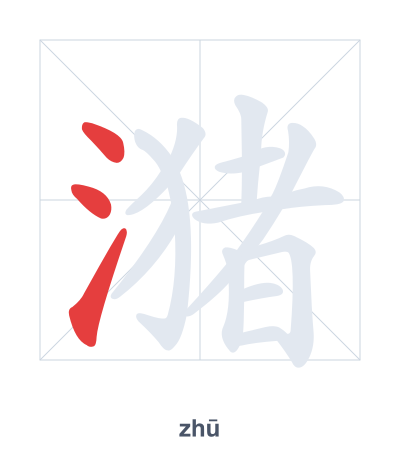
Open Hanzi Writer to see the animated stroke order and practice writing 潴 with real-time feedback.
The character 潴 (zhū) is written with 14 strokes. Follow the standard Chinese stroke order: top to bottom, left to right, outside before inside. The radical 氵 is one of its key components.
Practice the correct stroke order with the Hanzi Writer app to see animated stroke-by-stroke guidance with real-time feedback.
潴 means to stagnate or accumulate (of water).
潴 (zhū) combines the water radical 氵 with 猪 (zhū, 'pig'), recalling how pigs wallow in mud or water, causing it to stagnate and accumulate. This compound visually represents water trapped by a pig's activity.
💡 Memory Tip: Picture a pig (猪) sitting stubbornly in a puddle, blocking the water (氵) from flowing—it just stagnates there.
水分在体内潴留。
shuǐ fèn zài tǐ nèi zhū liú
Water is retained in the body.
这里的雨水有潴积。
zhè lǐ de yǔ shuǐ yǒu zhū jī
Rainwater has accumulated here.
农田里有很多潴水。
nóng tián lǐ yǒu hěn duō zhū shuǐ
There is a lot of stagnant water in the fields.
Open Hanzi Writer to see the animated stroke order and practice writing 潴 with real-time feedback.
✨ Animated stroke order · Handwriting recognition · HSK-graded practice · Free to use
潴 is made of two parts: the water radical 氵 on the left, and the phonetic component 猪 (zhū, meaning 'pig') on the right. The water radical indicates that the meaning involves water, while the right side provides the pronunciation zhū. Together they suggest water that is stuck or stagnant, like muddy water where a pig might wallow.