诌 (zhōu) means "To make up (stories) / To fabricate" in Chinese. It has 7 strokes with the radical 讠.
Rated 3.2/5 in difficulty (challenging).
Appears in 3+ common words including 胡诌 (hú zhōu), 编诌 (biān zhōu), 瞎诌 (xiā zhōu).
Due to its 7 strokes, Hanzi Writer's error detection shows 诌 requires focused practice — most learners need 10+ attempts for consistent accuracy.
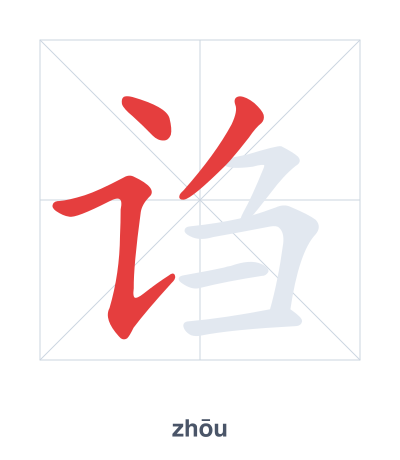
Open Hanzi Writer to see the animated stroke order and practice writing 诌 with real-time feedback.
The character 诌 (zhōu) is written with 7 strokes. Follow the standard Chinese stroke order: top to bottom, left to right, outside before inside. The radical 讠 is one of its key components.
Practice the correct stroke order with the Hanzi Writer app to see animated stroke-by-stroke guidance with real-time feedback.
诌 means To make up (stories) / To fabricate.
诌 is a phonetic compound combining the 'speech' radical 讠 with the phonetic component 刍 (chú, meaning 'hay' or 'to chew'). The imagery suggests 'speech like chewing hay' — rambling, rough talk — which evolved into the meaning of fabricating or making up stories.
💡 Memory Tip: Imagine a person speaking (讠) while chewing a mouthful of hay (刍) — they're just making up nonsense as they chew.
你别在这里瞎胡诌。
nǐ bié zài zhè lǐ xiā hú zhōu
Don't talk nonsense here.
这个故事是他编诌的。
zhè ge gù shì shì tā biān zhōu de
He made up this story.
他在瞎诌一些借口。
tā zài xiā zhōu yī xiē jiè kǒu
He is making up some excuses.
Open Hanzi Writer to see the animated stroke order and practice writing 诌 with real-time feedback.
✨ Animated stroke order · Handwriting recognition · HSK-graded practice · Free to use
诌 is made up of the radical 讠 (speech) on the left and the component 刍 on the right. The speech radical indicates that the character relates to talking or writing, while 刍 originally means "fodder" or "to chew" and here suggests something rough or made up. Together, they create the idea of using speech to create false or nonsense stories.