磔 (zhé) means "dismember / tear apart" in Chinese. It has 15 strokes with the radical 石.
Rated 4.2/5 in difficulty (advanced).
Appears in 3+ common words including 磔刑 (zhé xíng), 磔裂 (zhé liè), 磔格 (zhé gé).
Due to its 15 strokes, Hanzi Writer's error detection shows 磔 requires focused practice — most learners need 10+ attempts for consistent accuracy.
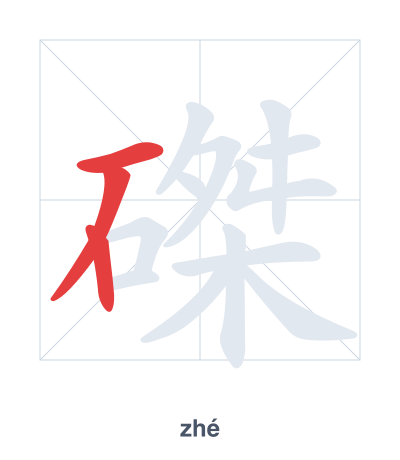
Open Hanzi Writer to see the animated stroke order and practice writing 磔 with real-time feedback.
The character 磔 (zhé) is written with 15 strokes. Follow the standard Chinese stroke order: top to bottom, left to right, outside before inside. The radical 石 is one of its key components.
Practice the correct stroke order with the Hanzi Writer app to see animated stroke-by-stroke guidance with real-time feedback.
磔 means dismember / tear apart.
The character 磔 combines the radical 石 (stone) with 桀 (jié, meaning 'cruel' or 'outstanding'), which also serves as a phonetic component. In ancient China, this referred to a brutal execution where the body was dismembered on a stone slab or by attaching limbs to stones and tearing them apart.
💡 Memory Tip: Picture a stone (石) slab with a cruel (桀) executioner pulling a victim's limbs apart—the stone anchors the torn body.
这种刑罚叫作磔刑。
zhè zhǒng xíng fá jiào zuò zhé xíng
This punishment is called dismemberment.
狂风磔裂了旗帜。
kuáng fēng zhé liè le qí zhì
The gale tore the flag to shreds.
树林里传来磔格的鸟鸣。
shù lín lǐ chuán lái zhé gé de niǎo míng
Sharp bird calls came from the woods.
Open Hanzi Writer to see the animated stroke order and practice writing 磔 with real-time feedback.
✨ Animated stroke order · Handwriting recognition · HSK-graded practice · Free to use
The character 磔 is composed of the radical 石 (stone) on the left and the component 桀 on the right. The stone radical hints at the use of stone tools in ancient punishments, while 桀 originally means "cruel" or "tyrant," reinforcing the brutal act of dismemberment. Together, they create a character that visualizes a harsh, stone-related execution.