铡 (zhá) means "To cut with a fodder cutter" in Chinese. It has 11 strokes with the radical 钅.
Rated 4.2/5 in difficulty (advanced).
Appears in 3+ common words including 铡草 (zhá cǎo), 铡刀 (zhá dāo), 铡断 (zhá duàn).
Due to its 11 strokes, Hanzi Writer's error detection shows 铡 requires focused practice — most learners need 10+ attempts for consistent accuracy.
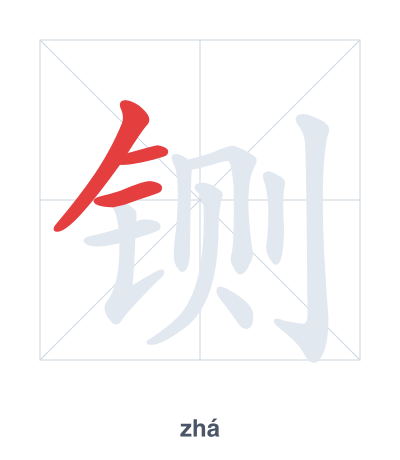
Open Hanzi Writer to see the animated stroke order and practice writing 铡 with real-time feedback.
The character 铡 (zhá) is written with 11 strokes. Follow the standard Chinese stroke order: top to bottom, left to right, outside before inside. The radical 钅 is one of its key components.
Practice the correct stroke order with the Hanzi Writer app to see animated stroke-by-stroke guidance with real-time feedback.
铡 means To cut with a fodder cutter.
铡 is a phono-semantic compound: the left radical 钅 (metal) indicates the tool is made of metal, while the right side 则 (zé, 'rule' or 'pattern') provides the pronunciation (though the tone shifts to zhá). Together they depict a metal fodder cutter that chops hay into regulated lengths.
💡 Memory Tip: Picture a metal blade (钅) that slices hay exactly to a ruler's rule (则), making perfect fodder portions.
农民在铡草。
nóng mín zài zhá cǎo
Farmers are chopping fodder.
他用铡刀切草。
tā yòng zhá dāo qiè cǎo
He used a fodder cutter to cut the grass.
把这些草铡断。
bǎ zhè xiē cǎo zhá duàn
Chop this grass with a fodder cutter.
Open Hanzi Writer to see the animated stroke order and practice writing 铡 with real-time feedback.
✨ Animated stroke order · Handwriting recognition · HSK-graded practice · Free to use
The character 铡 is made of the metal radical 钅 on the left and the character 则 (zé) on the right. The 钅 radical shows the blade is made of metal, while 则 originally meant 'rule' but here mainly provides the sound. Together, they create the idea of a metal tool used for cutting fodder or grass.