眢 (yuān) means "dried up; sunken" in Chinese. It has 10 strokes with the radical 目.
Rated 4.2/5 in difficulty (advanced).
Appears in 3+ common words including 眢井 (yuān jǐng), 眢眼 (yuān yǎn), 眢枯 (yuān kū).
Due to its 10 strokes, Hanzi Writer's error detection shows 眢 requires focused practice — most learners need 10+ attempts for consistent accuracy.
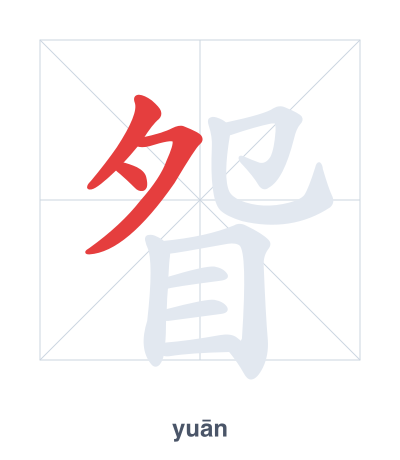
Open Hanzi Writer to see the animated stroke order and practice writing 眢 with real-time feedback.
The character 眢 (yuān) is written with 10 strokes. Follow the standard Chinese stroke order: top to bottom, left to right, outside before inside. The radical 目 is one of its key components.
Practice the correct stroke order with the Hanzi Writer app to see animated stroke-by-stroke guidance with real-time feedback.
眢 means dried up; sunken.
This compound character combines 目 (eye) with 夗 (to curl up or lie down), originally depicting an eye that has sunken into its socket or dried up, like in a corpse or from extreme thirst. The 夗 component adds the sense of something collapsed or shrunken, reinforcing the idea of the eye losing its moisture and volume.
💡 Memory Tip: Picture an eye (目) that is so dried up it has curled into a little wrinkled pit (夗).
这是一个眢井。
zhè shì yí gè yuān jǐng
This is a dry well.
他的眢眼很深。
tā de yuān yǎn hěn shēn
His sunken eyes are very deep.
井水已经眢枯了。
jǐng shuǐ yǐ jīng yuān kū le
The well water has already dried up.
Open Hanzi Writer to see the animated stroke order and practice writing 眢 with real-time feedback.
✨ Animated stroke order · Handwriting recognition · HSK-graded practice · Free to use
眢 is made of two parts: the top is 目 (eye radical) and the bottom is 夗 (yuān, which gives the sound and a sense of bending or curling). The eye radical connects the character to eyes, while 夗 suggests something sunken or dried up, so together 眢 describes eyes that are hollow or dried out.