钵 (bō) means "alms bowl / bowl" in Chinese. It has 10 strokes with the radical 钅.
Rated 4.2/5 in difficulty (advanced).
Appears in 3+ common words including 饭钵 (fàn bō), 钵子 (bō zi), 衣钵 (yī bō).
Due to its 10 strokes, Hanzi Writer's error detection shows 钵 requires focused practice — most learners need 10+ attempts for consistent accuracy.
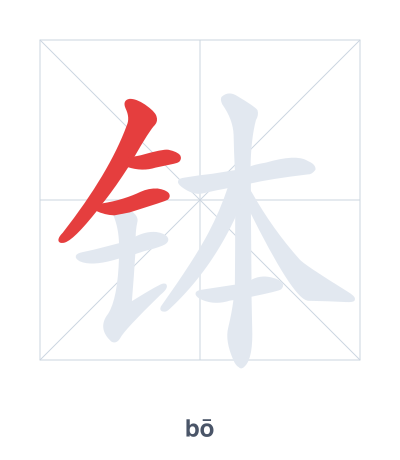
Open Hanzi Writer to see the animated stroke order and practice writing 钵 with real-time feedback.
The character 钵 (bō) is written with 10 strokes. Follow the standard Chinese stroke order: top to bottom, left to right, outside before inside. The radical 钅 is one of its key components.
Practice the correct stroke order with the Hanzi Writer app to see animated stroke-by-stroke guidance with real-time feedback.
钵 means alms bowl / bowl.
钵 is a phono-semantic compound. The radical 钅 (metal) hints at the bowl's material, while the component 本 (běn) originally contributed to its pronunciation (though the sound shifted). Together they represent a metal alms bowl used by Buddhist monks.
💡 Memory Tip: Picture a metal bowl (钅) with a giant root (本) growing out of it—the root is the alms food offered to a monk.
他手里拿着一个饭钵。
tā shǒu lǐ ná zhe yí gè fàn bō
He is holding an alms bowl in his hand.
这个钵子是用来盛饭的。
zhè ge bō zi shì yòng lái chéng fàn de
This bowl is used for serving rice.
他继承了老师的衣钵。
tā jì chéng le lǎo shī de yī bō
He carried on his teacher's legacy.
Open Hanzi Writer to see the animated stroke order and practice writing 钵 with real-time feedback.
✨ Animated stroke order · Handwriting recognition · HSK-graded practice · Free to use
The character 钵 has two parts: the left side is 钅 (metal radical) and the right side is 本 (běn, meaning 'root' or 'book'). Since alms bowls were traditionally made of metal, the radical 钅 directly hints at the material. The right side 本 may provide a loose phonetic clue, though the pronunciation differs slightly.