榆 (yú) means "Elm" in Chinese. It has 13 strokes with the radical 木.
Rated 4.2/5 in difficulty (advanced).
Appears in 3+ common words including 榆树 (yú shù), 榆钱 (yú qián), 榆木 (yú mù).
Due to its 13 strokes, Hanzi Writer's error detection shows 榆 requires focused practice — most learners need 10+ attempts for consistent accuracy.
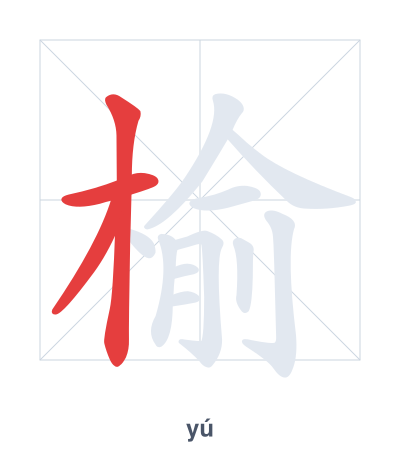
Open Hanzi Writer to see the animated stroke order and practice writing 榆 with real-time feedback.
The character 榆 (yú) is written with 13 strokes. Follow the standard Chinese stroke order: top to bottom, left to right, outside before inside. The radical 木 is one of its key components.
Practice the correct stroke order with the Hanzi Writer app to see animated stroke-by-stroke guidance with real-time feedback.
榆 means Elm.
榆 is a phono-semantic compound (形声字). The radical 木 (tree) indicates it is a type of tree, and the component 俞 (yú) contributes the sound. Together they form the character for elm, a tree known for its hard wood and distinctive winged seeds.
💡 Memory Tip: Picture an elm tree (木) with a giant, angry 'u' shaped branch (俞) that looks like a slingshot, ready to fling seeds at passersby.
路边有很多榆树。
lù biān yǒu hěn duō yú shù
There are many elm trees by the roadside.
春天可以吃榆钱。
chūn tiān kě yǐ chī yú qián
You can eat elm seeds in spring.
这把椅子是榆木的。
zhè bǎ yǐ zi shì yú mù de
This chair is made of elm wood.
Open Hanzi Writer to see the animated stroke order and practice writing 榆 with real-time feedback.
✨ Animated stroke order · Handwriting recognition · HSK-graded practice · Free to use
榆 is composed of the radical 木 (wood/tree) on the left, and the phonetic component 俞 (yú) on the right. The radical shows it is a type of tree, and the right part hints at the pronunciation. Together they form the character for elm tree.