淤 (yū) means "Silt or to clog" in Chinese. It has 11 strokes with the radical 氵.
Rated 4.2/5 in difficulty (advanced).
Appears in 3+ common words including 淤泥 (yū ní), 淤青 (yū qīng), 淤塞 (yū sè).
Due to its 11 strokes, Hanzi Writer's error detection shows 淤 requires focused practice — most learners need 10+ attempts for consistent accuracy.
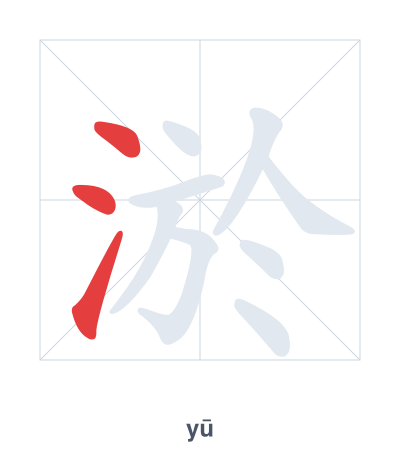
Open Hanzi Writer to see the animated stroke order and practice writing 淤 with real-time feedback.
The character 淤 (yū) is written with 11 strokes. Follow the standard Chinese stroke order: top to bottom, left to right, outside before inside. The radical 氵 is one of its key components.
Practice the correct stroke order with the Hanzi Writer app to see animated stroke-by-stroke guidance with real-time feedback.
淤 means Silt or to clog.
淤 combines the water radical (氵) with 於, which originally showed a crow or a resting place, acting phonetically while also hinting at stagnation. The compound evokes water that stands still and collects sediment, gradually forming silt or causing a blockage.
💡 Memory Tip: Picture water (氵) flowing slowly and piling up mud (the right side 於 looks like a small mound of dirt with a squiggle) until it clogs a drain completely.
池塘里有很多淤泥。
chí táng lǐ yǒu hěn duō yū ní
There is a lot of mud in the pond.
他的腿上有块淤青。
tā de tuǐ shàng yǒu kuài yū qīng
There is a bruise on his leg.
河道被淤塞了。
hé dào bèi yū sè le
The river channel is silted up.
Open Hanzi Writer to see the animated stroke order and practice writing 淤 with real-time feedback.
✨ Animated stroke order · Handwriting recognition · HSK-graded practice · Free to use
The left part is 氵, the radical for water, indicating the character relates to water. The right part is 於 (yú), which gives the sound and also suggests something that stays in water, like silt that clogs a river.