宥 (yòu) means "To forgive; to pardon." in Chinese. It has 9 strokes with the radical 宀.
Rated 4/5 in difficulty (challenging).
Appears in 3+ common words including 宽宥 (kuān yòu), 宥恕 (yòu shù), 宥免 (yòu miǎn).
Due to its 9 strokes, Hanzi Writer's error detection shows 宥 requires focused practice — most learners need 10+ attempts for consistent accuracy.
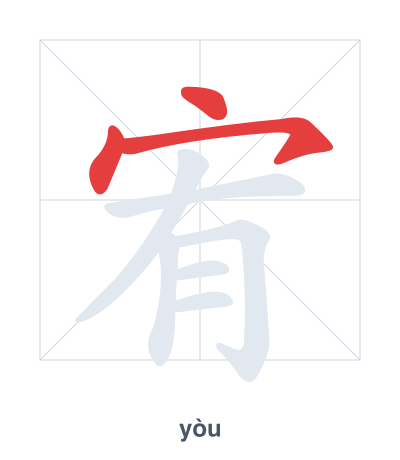
Open Hanzi Writer to see the animated stroke order and practice writing 宥 with real-time feedback.
The character 宥 (yòu) is written with 9 strokes. Follow the standard Chinese stroke order: top to bottom, left to right, outside before inside. The radical 宀 is one of its key components.
Practice the correct stroke order with the Hanzi Writer app to see animated stroke-by-stroke guidance with real-time feedback.
宥 means To forgive; to pardon..
宥 combines the radical 宀 (roof, shelter) with 有 (to have). Under a roof, one may choose to have leniency—offering forgiveness or pardon to someone seeking refuge.
💡 Memory Tip: Picture a roof (宀) over someone who has (有) done wrong, and you choose to let them stay—forgiving their mistake.
请宽宥我的过错。
qǐng kuān yòu wǒ de guò cuò
Please forgive my mistakes.
这种行为难以宥恕。
zhè zhǒng xíng wéi nán yǐ yòu shù
This behavior is hard to forgive.
法律宥免了他的罪。
fǎ lǜ yòu miǎn le tā de zuì
The law pardoned his crime.
Open Hanzi Writer to see the animated stroke order and practice writing 宥 with real-time feedback.
✨ Animated stroke order · Handwriting recognition · HSK-graded practice · Free to use
宥 is composed of the roof radical 宀 on top and the character 有 (yǒu, meaning "to have") below. The roof suggests shelter or protection, and combined with "to have," it implies having mercy or leniency, like offering forgiveness under a protective roof. This structure visually represents the idea of pardoning someone by providing them shelter from punishment.