镒 (yì) means "Yi (ancient unit of weight for gold)" in Chinese. It has 15 strokes with the radical 钅.
Rated 4.2/5 in difficulty (advanced).
Appears in 3+ common words including 镒金 (yì jīn), 万镒 (wàn yì), 一镒 (yī yì).
Due to its 15 strokes, Hanzi Writer's error detection shows 镒 requires focused practice — most learners need 10+ attempts for consistent accuracy.
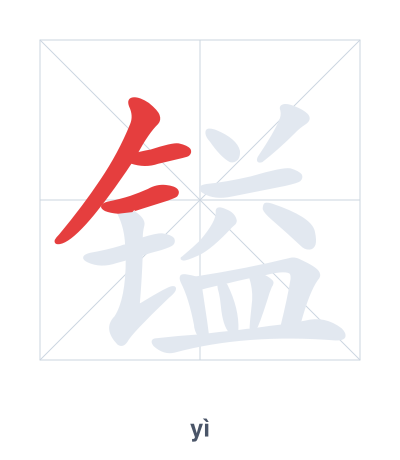
Open Hanzi Writer to see the animated stroke order and practice writing 镒 with real-time feedback.
The character 镒 (yì) is written with 15 strokes. Follow the standard Chinese stroke order: top to bottom, left to right, outside before inside. The radical 钅 is one of its key components.
Practice the correct stroke order with the Hanzi Writer app to see animated stroke-by-stroke guidance with real-time feedback.
镒 means Yi (ancient unit of weight for gold).
镒 is a compound character with the radical 钅 (gold/metal) and the phonetic component 益 (yì, meaning 'abundant' or 'increase'). The character was created to represent a standard unit of gold weight, suggesting 'an abundance of gold' measured out.
💡 Memory Tip: Picture a golden scale (钅) with a bowl overflowing (益) with gold coins, each coin weighing exactly one 镒.
古代用镒金作为单位。
gǔ dài yòng yì jīn zuò wéi dān wèi
Ancient times used 'yi' gold as a unit of weight.
他的家产有万镒之多。
tā de jiā chǎn yǒu wàn yì zhī duō
His family fortune is worth tens of thousands of gold pieces.
这一镒金子很沉重。
zhè yī yì jīn zi hěn chén zhòng
This weight of gold is very heavy.
Open Hanzi Writer to see the animated stroke order and practice writing 镒 with real-time feedback.
✨ Animated stroke order · Handwriting recognition · HSK-graded practice · Free to use
镒 is a phono-semantic compound. The left radical 钅 means metal or gold, indicating the character relates to precious metals. The right part 益 provides the pronunciation yì, and together they form the meaning of an ancient unit of weight for gold.