奕 (yì) means "grand; great; graceful" in Chinese. It has 9 strokes with the radical 大.
Rated 4/5 in difficulty (challenging).
Appears in 3+ common words including 神采奕奕 (shén cǎi yì yì), 奕奕 (yì yì), 博弈 (bó yì).
Due to its 9 strokes, Hanzi Writer's error detection shows 奕 requires focused practice — most learners need 10+ attempts for consistent accuracy.
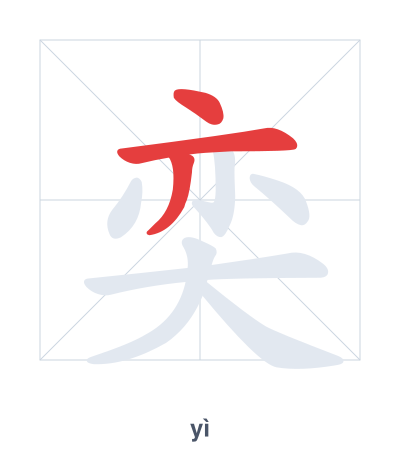
Open Hanzi Writer to see the animated stroke order and practice writing 奕 with real-time feedback.
The character 奕 (yì) is written with 9 strokes. Follow the standard Chinese stroke order: top to bottom, left to right, outside before inside. The radical 大 is one of its key components.
Practice the correct stroke order with the Hanzi Writer app to see animated stroke-by-stroke guidance with real-time feedback.
奕 means grand; great; graceful.
奕 combines the radical 大 (dà, 'big, grand') as a semantic component indicating largeness or grandeur, with 亦 (yì) serving as a phonetic hint for the pronunciation. The character thus visually suggests something both great in scale and graceful in form.
💡 Memory Tip: Imagine a grand figure (大) striking a graceful pose, with the 'also' (亦) mark on their chest to show they're also elegant.
他看起来神采奕奕。
tā kàn qǐ lái shén cǎi yì yì
He looks glowing with spirits.
他的目光奕奕有神。
tā de mù guāng yì yì yǒu shén
His eyes are bright and full of spirit.
这是一个博弈的过程。
zhè shì yí gè bó yì de guò chéng
This is a process of strategic gaming.
Open Hanzi Writer to see the animated stroke order and practice writing 奕 with real-time feedback.
✨ Animated stroke order · Handwriting recognition · HSK-graded practice · Free to use
奕 combines the radical 大 (big) on top with the phonetic component 亦 (yì, also). The big radical suggests greatness or grandeur, and together with the sound component, it conveys the meaning of being grand, great, or graceful.