呓 (yì) means "to talk in one's sleep" in Chinese. It has 7 strokes with the radical 口.
Rated 3.5/5 in difficulty (challenging).
Appears in 3+ common words including 梦呓 (mèng yì), 呓语 (yì yǔ), 呓症 (yì zhèng).
Due to its 7 strokes, Hanzi Writer's error detection shows 呓 requires focused practice — most learners need 10+ attempts for consistent accuracy.
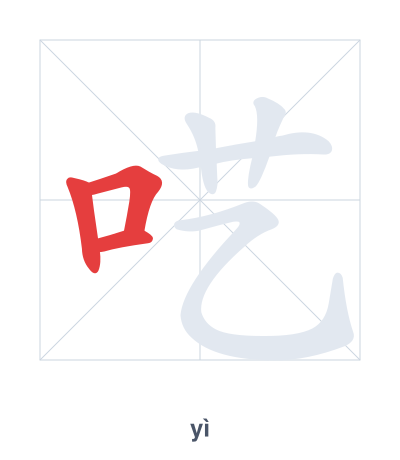
Open Hanzi Writer to see the animated stroke order and practice writing 呓 with real-time feedback.
The character 呓 (yì) is written with 7 strokes. Follow the standard Chinese stroke order: top to bottom, left to right, outside before inside. The radical 口 is one of its key components.
Practice the correct stroke order with the Hanzi Writer app to see animated stroke-by-stroke guidance with real-time feedback.
呓 means to talk in one's sleep.
呓 is a phono-semantic compound: the radical 口 (mouth) indicates speech, and the phonetic component 艺 (yì) hints at the pronunciation. Together, they refer to talking involuntarily during sleep.
💡 Memory Tip: Imagine a mouth (口) that keeps babbling about its artistic skills (艺) while asleep—sleep-talking about art.
他在说梦呓。
tā zài shuō mèng yì
He is talking in his sleep.
别听他的呓语。
bié tīng tā de yì yǔ
Don't listen to his nonsense.
他得了呓症。
tā dé le yì zhèng
He suffered from delirium or sleep-talking.
Open Hanzi Writer to see the animated stroke order and practice writing 呓 with real-time feedback.
✨ Animated stroke order · Handwriting recognition · HSK-graded practice · Free to use
呓 is composed of the radical 口 (mouth) on the left and the phonetic component 艺 (yì) on the right. The mouth radical indicates that the meaning involves speaking, while 艺 provides the sound. Together, they represent the idea of speaking from the mouth during sleep, which is talking in one's sleep.