佾 (yì) means "a row of dancers in ritual ceremonies" in Chinese. It has 8 strokes with the radical 亻.
Rated 3.4/5 in difficulty (challenging).
Appears in 3+ common words including 佾舞 (yì wǔ), 八佾 (bā yì), 佾生 (yì shēng).
Due to its 8 strokes, Hanzi Writer's error detection shows 佾 requires focused practice — most learners need 10+ attempts for consistent accuracy.
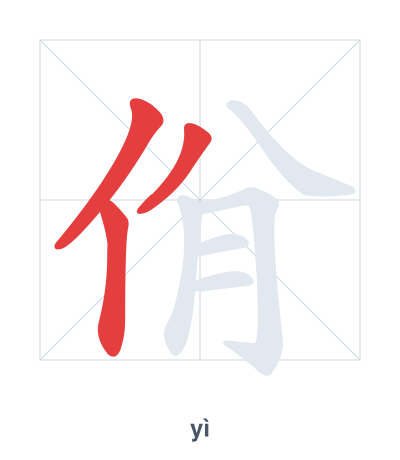
Open Hanzi Writer to see the animated stroke order and practice writing 佾 with real-time feedback.
The character 佾 (yì) is written with 8 strokes. Follow the standard Chinese stroke order: top to bottom, left to right, outside before inside. The radical 亻 is one of its key components.
Practice the correct stroke order with the Hanzi Writer app to see animated stroke-by-stroke guidance with real-time feedback.
佾 means a row of dancers in ritual ceremonies.
The character 佾 combines the person radical (亻) with eight (八) and a moon/meat component (月), symbolizing a row of eight dancers in ancient Chinese court rituals. Historically, a '佾' was a specific formation of dancers, and the visual elements suggest a person among eight participants arranged in order.
💡 Memory Tip: Picture a person (亻) leading eight (八) dancers beneath the moon (月) in a perfectly aligned row.
他们在跳传统的佾舞。
tā men zài tiào chuán tǒng de yì wǔ
They are performing the traditional Yi dance.
八佾舞是古代的礼仪。
bā yì wǔ shì gǔ dài de lǐ yí
The Bayi dance is an ancient ritual.
他是一名优秀的佾生。
tā shì yī míng yōu xiù de yì shēng
He is an excellent ritual dancer.
Open Hanzi Writer to see the animated stroke order and practice writing 佾 with real-time feedback.
✨ Animated stroke order · Handwriting recognition · HSK-graded practice · Free to use
佾 is made of the radical 亻 on the left, which means 'person,' and a phonetic component on the right that sounds like yì. So the character literally means a person who performs in a ritual dance row.