黍 (shǔ) means "broomcorn millet" in Chinese. It has 12 strokes with the radical 黍.
Rated 3.5/5 in difficulty (challenging).
Appears in 3+ common words including 黍米 (shǔ mǐ), 玉黍 (yù shǔ), 黍子 (shǔ zi).
Due to its 12 strokes, Hanzi Writer's error detection shows 黍 requires focused practice — most learners need 10+ attempts for consistent accuracy.
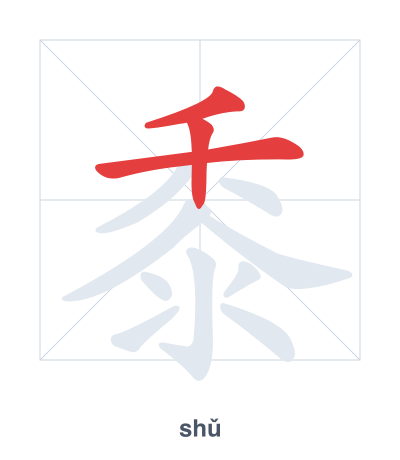
Open Hanzi Writer to see the animated stroke order and practice writing 黍 with real-time feedback.
The character 黍 (shǔ) is written with 12 strokes. Follow the standard Chinese stroke order: top to bottom, left to right, outside before inside. The radical 黍 is one of its key components.
Practice the correct stroke order with the Hanzi Writer app to see animated stroke-by-stroke guidance with real-time feedback.
黍 means broomcorn millet.
| Character | 黍 |
| Pinyin | shǔ (shu) |
| Meaning | broomcorn millet |
| Strokes | 12 |
| Radical | 黍 |
| Difficulty | 3.5/5 |
黍 is a pictograph of a broomcorn millet plant, with ancient oracle bone forms showing a stalk bearing drooping clusters of seeds. The modern character combines 禾 (grain) on top and 氺 (water) beneath, reflecting how millet becomes sticky when cooked with water.
💡 Memory Tip: Imagine a tall stalk of grain (禾) standing in a puddle of water (氺) that makes the seeds sticky—that's broomcorn millet.
黍米是五谷之一。
shǔ mǐ shì wǔ gǔ zhī yī
Millet is one of the five grains.
玉黍就是玉米。
yù shǔ jiù shì yù mǐ
'Yushu' is just another name for corn.
这种植物叫黍子。
zhè zhòng zhí wù jiào shǔ zi
This plant is called broomcorn millet.
Open Hanzi Writer to see the animated stroke order and practice writing 黍 with real-time feedback.
✨ Animated stroke order · Handwriting recognition · HSK-graded practice · Free to use
The character 黍 is composed of two parts: the top is 禾 (grain/rice plant) and the bottom is 水 (water). This structure suggests that broomcorn millet is a grain that grows well in moist conditions. Understanding this helps you connect the character to its meaning.