杳 (yǎo) means "remote; vague; no trace" in Chinese. It has 8 strokes with the radical 木.
Rated 3.7/5 in difficulty (challenging).
Appears in 3+ common words including 杳无音信 (yǎo wú yīn xìn), 杳然 (yǎo rán), 杳无踪影 (yǎo wú zōng yǐng).
Due to its 8 strokes, Hanzi Writer's error detection shows 杳 requires focused practice — most learners need 10+ attempts for consistent accuracy.
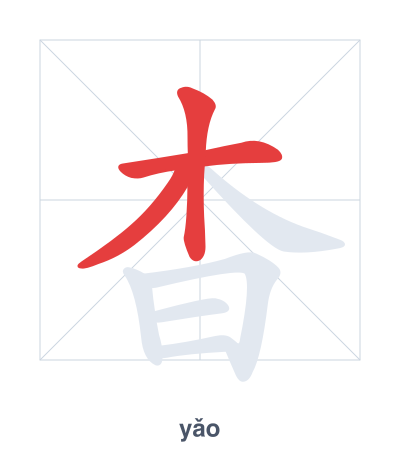
Open Hanzi Writer to see the animated stroke order and practice writing 杳 with real-time feedback.
The character 杳 (yǎo) is written with 8 strokes. Follow the standard Chinese stroke order: top to bottom, left to right, outside before inside. The radical 木 is one of its key components.
Practice the correct stroke order with the Hanzi Writer app to see animated stroke-by-stroke guidance with real-time feedback.
杳 means remote; vague; no trace.
杳 is a compound character combining 木 (tree) and 日 (sun). The sun placed below the tree depicts the sun setting behind the trees, creating darkness and obscurity, hence meanings like 'remote' and 'no trace'.
💡 Memory Tip: Imagine the sun (日) has slipped beneath the tree (木), leaving no trace of light—everything becomes dark and remote.
他从此杳无音信。
tā cóng cǐ yǎo wú yīn xìn
He hasn't been heard from since then.
他的消息杳然。
tā de xiāo xī yǎo rán
There has been no news of him.
小猫杳无踪影。
xiǎo māo yǎo wú zōng yǐng
The kitten has vanished without a trace.
Open Hanzi Writer to see the animated stroke order and practice writing 杳 with real-time feedback.
✨ Animated stroke order · Handwriting recognition · HSK-graded practice · Free to use
杳 is made of 木 (tree or wood) on top of 日 (sun). This combination suggests the sun has sunk below the trees, creating a feeling of darkness, distance, or disappearance. That is why 杳 means "remote," "vague," or "no trace."